
A framing inspection can go perfectly and still leave a project exposed to delays if the insulation scope is vague, the crew arrives late, or the installation misses the details that affect code and comfort. Choosing the right insulation contractor for builders means selecting a trade partner who understands more than material coverage. They need to understand the building envelope, local requirements, sequencing, and the cost of fixing problems after drywall is installed.
For builders and remodelers across New Hampshire, Massachusetts, Maine, and Vermont, insulation is a performance-critical scope. It influences heating loads, summer humidity, room-to-room comfort, moisture management, sound control, and final inspection results. The right contractor helps protect the schedule while delivering a home or commercial space that performs as promised.
What Builders Need From an Insulation Contractor
A dependable insulation partner should be able to review plans, identify likely air-leakage paths, recommend appropriate materials, and coordinate installation around the rest of the job. That requires more than a crew with insulation equipment. It requires practical building-science knowledge and a disciplined approach to installation.
Builders should expect clear communication before work begins. The insulation contractor should confirm the scope, identify areas requiring special attention, and explain where air sealing, vapor control, fire blocking, or baffles may be needed. On a tight construction schedule, ambiguity creates expensive gaps. A clearly defined scope helps prevent a return trip, failed inspection, or last-minute change order.
The contractor should also be prepared to work within the actual conditions of the project. New construction, additions, deep energy retrofits, and occupied-home remodels all require different planning. Open wall cavities are straightforward compared with a renovation involving irregular framing, existing mechanical systems, or hard-to-reach rooflines. Experience with both conditions matters.
Insulation Contractor for Builders: Performance Before Product
There is no single insulation product that fits every assembly. A contractor who recommends the same material for every attic, wall, crawlspace, and basement may be simplifying a decision that deserves more attention. The best choice depends on the building design, available cavity depth, climate exposure, budget, code targets, and the role insulation must play within the assembly.
Spray Foam for Air Control and Tight Spaces
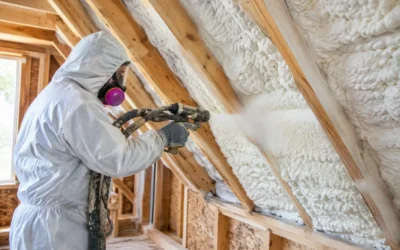
Spray foam can provide high R-value in limited space while also reducing air movement through many common leakage points. It is often useful at rim joists, roof decks, complex framing transitions, cantilevers, and areas where conventional insulation alone may leave gaps.
Closed-cell foam can add moisture resistance and structural rigidity in certain applications. Open-cell foam may be appropriate where sound reduction, air sealing, and cavity filling are priorities. The correct choice depends on the assembly and whether vapor control is required. In New England, that conversation should account for winter vapor drive, roof design, and the way the entire wall or roof system dries.
Colonial Insulation uses next-generation HFO spray foam options that provide strong thermal performance while helping builders address demanding building-envelope details.
Blown Cellulose for Dense, Complete Coverage
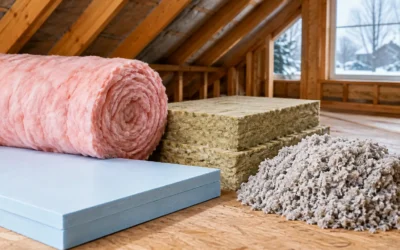
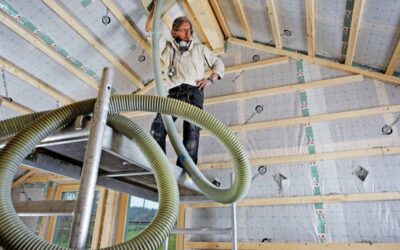
Blown cellulose is a practical option for attics and enclosed wall cavities. When installed to the right density and depth, it fills around wiring and irregular framing better than many loosely placed batts. It also offers a recycled-content option for projects where sustainability is part of the specification.
For attics, the depth must match the required R-value and remain even across the entire area. A thin section near the eaves or an uninsulated attic hatch can undermine the performance of an otherwise well-installed attic system. Proper air sealing below the attic insulation is equally important.
Fiberglass and Mineral Wool for Flexible Assembly Design
Fiberglass remains a cost-effective choice for many wall and floor assemblies when it is properly fitted. The key is installation quality. Compressed batts, gaps around obstructions, and unfilled corners reduce real-world performance. A stated R-value only works when the material is installed without voids.
Mineral wool can be a strong fit where fire resistance, moisture tolerance, and sound control are priorities. Its density and dimensional stability make it useful in exterior walls, partition walls, and assemblies that need added acoustic separation. It may cost more than fiberglass, but the additional performance can be worthwhile in multifamily, commercial, or high-end residential applications.
Air Sealing Is Not an Optional Add-On
Insulation slows heat transfer. Air sealing limits the uncontrolled movement of air that carries heat and moisture through the building shell. Both are necessary for dependable performance.
A home can have thick attic insulation and still feel drafty if air is leaking through top plates, plumbing penetrations, recessed fixtures, attic access points, rim joists, and chases around ducts or wiring. In winter, those leaks can carry warm, moist interior air into cold cavities, where condensation may create long-term moisture concerns. During humid summers, uncontrolled infiltration can make cooling systems work harder and leave rooms less comfortable.
For builders, treating air sealing as a defined scope protects the finished project. It helps support lower utility costs, more consistent indoor temperatures, and improved indoor air quality. It can also make it easier to meet blower-door targets where testing is required or specified.
The process should be coordinated with other trades. Electricians, plumbers, HVAC installers, and low-voltage contractors all create penetrations in the air barrier. A knowledgeable insulation contractor identifies the locations that need attention and helps ensure they are addressed before those areas become inaccessible.
New England Codes and Inspection Readiness
Code compliance is not just about meeting a number on a plan. It is about installing the specified R-values correctly, maintaining continuity at transitions, managing required vapor retarders, and documenting the work when needed. Requirements vary by state and project type, so builders need a contractor familiar with the local code environment.
An inspection-ready installation starts with the details. Exterior-wall insulation should be continuous and complete within the cavity. Attic insulation must reach the required depth without blocking ventilation pathways. Roof assemblies need the right balance of thermal control, air control, and moisture management. Fire-rated assemblies and penetrations must be handled according to the applicable requirements.
This is where regional experience pays off. New England’s long heating season, snow loads, humid summer conditions, and wide temperature swings place real demands on the building envelope. A detail that appears adequate on paper can create condensation risk or comfort complaints if it is not suited to the local climate zone and assembly design.
Schedule Reliability Protects the Entire Job
Insulation often sits between major construction milestones. The framing needs to be ready, rough mechanical work needs to be complete, and drywall cannot begin until insulation and inspections are finished. A missed installation window can affect several trades at once.
Builders should look for a contractor that confirms readiness requirements early and communicates quickly if site conditions change. That includes knowing when insulation must wait for mechanical corrections, framing repairs, roof leaks, or moisture issues. Installing material over unresolved problems may keep the calendar moving for a day, but it can create larger problems later.
Reliable scheduling also includes having the right equipment, materials, and trained crew for the job. Large attic blow-ins, spray foam applications, multifamily units, and detailed remodeling work require different levels of planning. A contractor should be honest about lead times and realistic about the duration of each phase.
Questions to Ask Before You Award the Scope
Before selecting an insulation contractor, ask how they approach air sealing, which materials they recommend for the specific assemblies, and how they verify coverage and installation quality. Ask whether they have experience with the applicable state code and whether they coordinate with blower-door testing or energy-audit requirements when relevant.
It is also reasonable to ask how they handle changes in the field. Plans do not always reflect every framing condition, mechanical chase, or renovation surprise. A capable contractor will explain the options, the performance implications, and the cost impact before proceeding.
Price matters, but the lowest bid may not include the air sealing, material depth, access preparation, protection, or detail work needed to achieve the expected result. Compare scopes line by line. A complete, well-defined proposal is usually a better indicator of value than a low number with unanswered questions.
Build for the Comfort Your Clients Expect
Your clients may never see the insulation behind their walls, but they will notice cold floors, noisy rooms, ice dams, uneven temperatures, and high energy bills. Those issues can become callbacks that affect both your margin and your reputation.
A qualified insulation contractor helps prevent those outcomes by treating insulation as part of a complete building-performance system. For a new home, addition, remodel, or commercial project, a clear scope and an experienced local crew can keep the work moving toward inspection while delivering the comfort and efficiency clients expect for years to come. When the details matter, request a project-specific quote before insulation becomes the last task standing between your job and drywall.