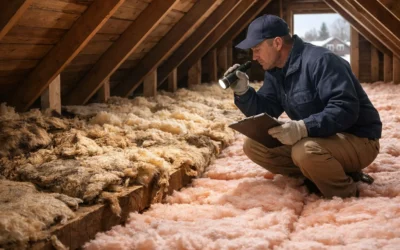

A roofline that sweats in January, a bonus room that never matches the thermostat, or a damp basement wall can turn an insulation decision into a building-performance problem. The closed cell versus open cell spray foam choice affects more than R-value. It influences air leakage, moisture movement, structural needs, available space, and the long-term comfort of a New England home or commercial building.
Both products can be effective when they are installed in the right location and at the right thickness. The better option is not determined by a single number on a product label. It depends on the assembly, the condition of the building, local code requirements, and the problems the insulation needs to solve.
Closed Cell Versus Open Cell: The Core Difference
Spray foam expands after application, filling cracks, seams, and irregular cavities that are difficult to address with many other insulation materials. The difference lies in the foam’s internal structure.
Open-cell foam contains tiny cells that are not fully sealed. This makes it lighter, softer, and more vapor-permeable. It expands significantly as it is installed, helping it fill complex framing bays and hard-to-reach areas.
Closed-cell foam is denser because its cells are sealed and filled with a blowing agent. It expands less than open-cell foam, but it delivers more insulating value per inch and resists water vapor far more effectively. Modern HFO closed-cell foam also provides high performance with a lower global warming impact than older spray foam formulations.
Both types create an air seal when properly installed. That matters in New Hampshire, Massachusetts, Maine, and Vermont, where winter air leakage can drive heat loss, drafts, and ice-dam risk, while humid summer air can create moisture concerns in poorly controlled assemblies.
When Closed-Cell Foam Makes Sense
Closed-cell spray foam is often the right fit where space is limited and high thermal performance is required. Depending on the product, it can provide roughly R-6 to R-7 per inch. That allows a contractor to achieve meaningful R-value in a shallow wall cavity, rim joist, basement wall, or compact roof assembly.
Its moisture resistance is another major advantage. Closed-cell foam can serve as a vapor retarder at sufficient thickness, which is valuable in locations exposed to cold surfaces or occasional moisture. Foundation walls, crawl spaces, garage ceilings, cantilevers, and the underside of roof decks are common applications, provided the full assembly is designed correctly.
Because it is dense and rigid, closed-cell foam can also add strength to certain wall and roof assemblies. That should be viewed as an added benefit rather than a substitute for engineered structural design, but it can be useful in demanding applications.
The trade-off is cost. Closed-cell foam uses more material and is generally more expensive per inch than open-cell foam. It also requires experienced installation crews that can control thickness, adhesion, and curing conditions. Applying it too thickly in one pass can affect foam quality, so professional technique is central to performance.
Closed-cell foam is not automatically the best choice for every attic or wall. If a project has deep cavities and no moisture-management reason to use dense foam, the higher cost may not produce enough additional value. A building assessment should identify whether its compact profile and vapor control are actually needed.
Common Closed-Cell Applications
Closed-cell foam is frequently specified for rim joists, basement and crawl-space walls, cathedral ceilings with limited depth, and unvented roof assemblies. It can also be a practical solution for metal buildings and commercial projects where condensation control is a primary concern.
In renovation work, it is particularly useful when access is limited. A thin layer can air-seal and insulate an irregular area that would be difficult to treat with batts alone. In some assemblies, it is paired with other insulation materials to balance cost, R-value, and moisture performance.
Where Open-Cell Foam Performs Well
Open-cell foam typically provides about R-3.5 to R-4 per inch. It needs greater thickness than closed-cell foam to reach the same R-value, but in a deep attic or wall cavity, that may not be a limitation. Its expansion makes it effective at sealing around wiring, plumbing, and uneven framing.
Open-cell foam is often selected for the underside of roof sheathing in an unvented attic where the assembly can safely dry and the design includes appropriate vapor control for the local climate. It can bring ductwork and mechanical equipment inside the conditioned envelope, reducing temperature extremes and helping HVAC systems operate more efficiently.
It also offers useful sound reduction because of its softer, more open structure. While no insulation will make a room fully soundproof, open-cell foam can reduce airborne noise between interior spaces and from exterior sources. That can be beneficial in home offices, bedrooms, multifamily properties, and commercial interiors.
The key limitation is moisture. Open-cell foam is air-impermeable at the appropriate installed thickness, but it is not a vapor barrier and can absorb water. It should not be the default choice against damp foundation walls, below grade, or in areas where bulk-water intrusion is possible. Those conditions need drainage, waterproofing, and moisture corrections first, not insulation applied over the problem.
Open-cell foam is generally less expensive than closed-cell foam for large-volume applications. That can make it a sensible option for rooflines and open wall cavities, especially when the project can accommodate the required thickness. The best value comes from using it where its expansion, air sealing, and acoustic benefits align with the building’s needs.
Moisture Control Requires More Than Foam Choice
New England buildings experience long heating seasons, large temperature swings, snow loads, wind-driven rain, and humid summer weather. A successful insulation plan must manage air, heat, and moisture together.
Air leaks are especially important because moving air carries far more moisture than vapor diffusion through painted drywall. Sealing attic penetrations, top plates, rim joists, duct openings, and framing transitions can prevent conditioned air from escaping into cold cavities. Spray foam can perform this role well, but it must connect continuously with other air-control layers in the building.
Vapor control is more specific. The right approach depends on the climate zone, the wall or roof assembly, exterior insulation, interior finishes, and whether the structure needs to dry inward, outward, or both. A foam selection that works well for one roof may be inappropriate for another. Builders and remodelers should treat vapor retarder requirements as an assembly decision, not a material shortcut.
If a building has an existing roof leak, wet sheathing, foundation seepage, or signs of mold, correct the moisture source before insulating. Encapsulating wet materials can conceal damage and create a more expensive repair later.
R-Value, Air Sealing, and Code Compliance
R-value measures resistance to heat flow, which is why closed-cell foam earns attention in tight spaces. But R-value alone does not tell the full story. Gaps around batts, unsealed penetrations, compression, and missing coverage can undermine an otherwise high-R-value design.
A well-installed air barrier can improve room-to-room temperature balance and reduce the workload on heating and cooling equipment. For homeowners, that can mean fewer cold floors and less reliance on space heaters. For builders, it can mean fewer comfort callbacks and a more dependable path to blower-door targets and inspection requirements.
State and local codes may require prescribed insulation levels, ignition barriers, thermal barriers, or specific documentation for foam plastic installation. Requirements differ by project type and jurisdiction. Qualified installers understand that spray foam is not finished simply because it has been applied. Details such as depth verification, fire-protection requirements, ventilation planning, and inspection coordination matter.
Can You Combine Foam With Other Insulation?
Yes. Hybrid insulation systems are often a practical way to get air sealing where it matters most while managing material cost across larger areas. For example, a project may use closed-cell foam at rim joists or a thin layer against roof sheathing, then add blown cellulose, fiberglass, or mineral wool to reach the desired overall R-value.
This approach can work well in new construction and renovations, but the layers must be designed in the correct order. The wrong combination can trap moisture or leave an air path behind the insulation. It is worth reviewing the full assembly before work begins, particularly in older homes with unknown air leaks and varying cavity depths.
Choose the Foam That Solves the Actual Problem
Closed-cell foam is usually the stronger candidate when a project needs maximum R-value in limited space, added moisture resistance, or a durable air seal in a demanding location. Open-cell foam can be the better value in larger cavities where sound control, broad coverage, and air sealing matter more than vapor resistance.
The right answer may also be cellulose, fiberglass, mineral wool, or a carefully designed combination of materials. Colonial Insulation evaluates the building conditions behind the symptom, whether that symptom is a cold bedroom, ice dams, high utility bills, condensation, or an insulation plan that must pass inspection on schedule.
Before choosing foam, look beyond the cavity. A clear assessment of air leakage, moisture conditions, ventilation, framing depth, and code requirements will lead to a solution that keeps the building more comfortable through every New England season.