
The Mass Save insulation rebate pays 75 to 100 percent of approved insulation and air sealing work in Massachusetts homes of one to four units. The size of your discount depends on what a Home Energy Assessment finds and on your household income. The rebate is taken off the insulation contract, so the work has to be scoped properly before it starts. That is where a crew with blower door and thermal imaging diagnostics earns its keep. We install insulation across New Hampshire, southern Maine, Vermont and north-central Massachusetts (Fitchburg, Gardner, Leominster), and we do energy audits with exactly those tools.
TL;DR
- Mass Save offers 75–100% off approved insulation and no-cost targeted air sealing for homes with 1 to 4 units. Offers can change or be cancelled, so check the live program page before you sign.
- Income-eligible households, and residents of Designated Equity Communities, can qualify for 100% off insulation and air sealing.
- The path is a no-cost Home Energy Assessment (up to 2.5 hours), then a contractor installs the recommended work, and the discount is applied to the contract.
- Rebates sent in separately usually take 6 to 8 weeks online and longer by mail. A 0% HEAT Loan of up to $25,000 is available through participating lenders, subject to approval.
- Living in New Hampshire? The equivalent program is NHSaves, and we are an NHSaves contractor.
Table of Contents
- What the Mass Save insulation rebate is
- How much it pays
- Who qualifies
- What gets insulated
- Barriers that can hold up the work
- Step by step: from assessment to rebate
- A worked example
- Living in New Hampshire, Maine or Vermont
- Getting the most out of the rebate
- How we help
- FAQ
- Sources
What the Mass Save insulation rebate is
Mass Save is Massachusetts’ statewide energy efficiency program. It is run by a collaborative of utilities and gas companies: Berkshire Gas, Cape Light Compact, Eversource, Liberty, National Grid and Unitil. Your electric or gas utility decides which sponsor’s page you use, but the offers are largely the same statewide.
For insulation, the structure is simple. A trained Energy Specialist looks at your house and recommends work. If your attic, walls or basement qualify, the program covers most or all of the cost of the insulation, and it covers targeted air sealing at leakage points such as attics, basements and the spaces between floor joists.
Mass Save says insulation and air sealing can lower heating and cooling costs by up to 15 percent. It also lists fewer drafts, less outside noise and a lower chance of ice dams among the benefits. In an older New England house, ice dams are often the symptom that sends people looking in the first place. Our write-up of ice dam prevention examples for New England homes shows what the fix looks like in practice.
How much it pays
There are two layers, and it helps to keep them apart.
Standard incentive. Cape Light Compact’s 2026 insulation table lists 75% off insulation and 100% off air sealing as the standard incentive, applied to the insulation contract for the 1/1/26 to 12/31/26 period. Its income-qualified customers, year-round renters and Oak Bluffs and Tisbury residents get 100% on both.
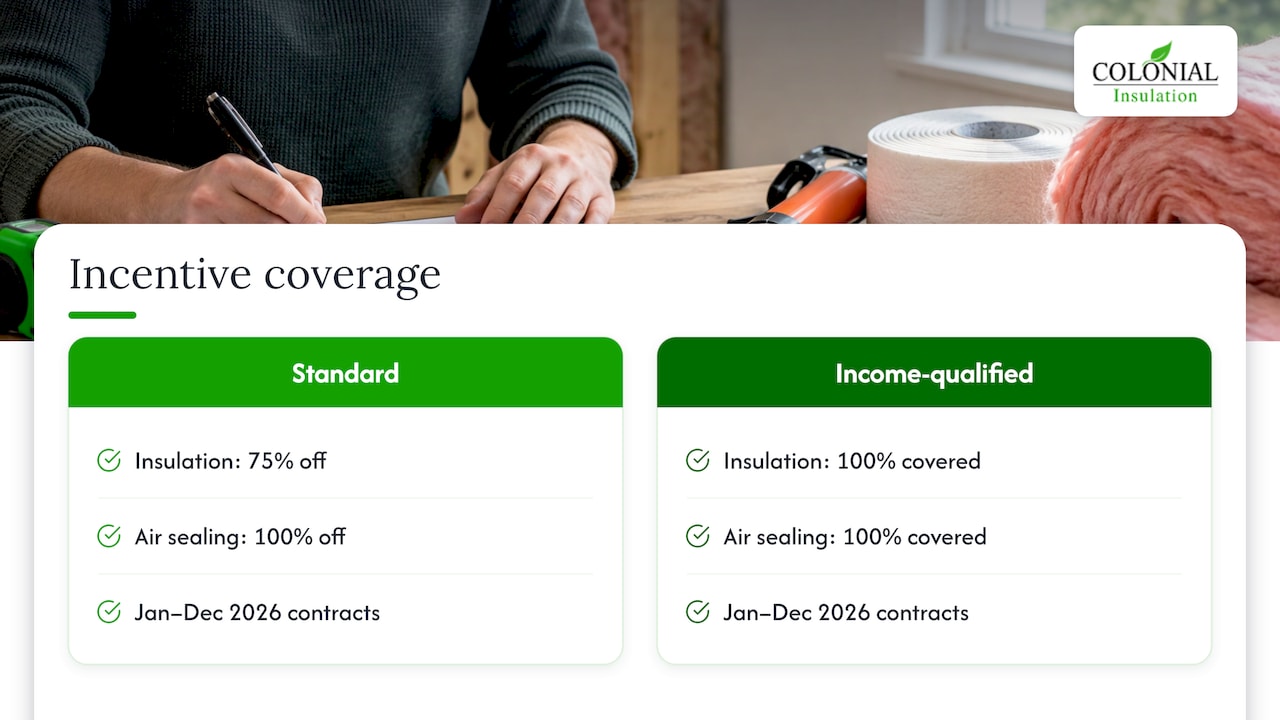
Income-based and equity offers. Households that qualify by income, or that live in a Designated Equity Community, can get the full cost covered. More on that below.
Beyond insulation, Mass Save’s post-assessment incentives also include rebates of up to $8,500 on qualifying heating, cooling and water-heating equipment, plus 0% financing through the HEAT Loan. The HEAT Loan covers up to $25,000 for qualified home improvements and requires approval from a participating lender.
Two cautions belong right here. First, Mass Save states that offers are subject to change or cancellation, so always read the current terms on the program page before you commit. Second, some rebate eligibility depends on what the Home Energy Assessment finds. A home that is already well insulated in one area may qualify for less work than the one next door.
Who qualifies
The basic rule is that you live in a 1- to 4-unit home. Renters, landlords of 1 to 4 units and landlords of 5-plus-unit buildings each have their own offers. A tenant needs the landlord’s approval before work on the building.
Income-eligible households
For the 2026–2027 heating season, Mass Save’s Income Eligible Program limits start at $53,585 for a one-person household and reach $103,049 for four people. Qualifying homeowners and renters can receive no-cost additional attic, wall and basement insulation, air sealing, and other upgrades such as heat pump replacements and smart thermostats.
There is also an Enhanced Incentive tier above those limits. For a four-person household, that means income of $103,050 to $137,399. Eversource describes the same group as households of four making less than $137,400 who may qualify for a no-cost package including insulation, air sealing and heat pumps. These limits are set per heating season, so look up your own household size on the live table before you assume anything.
Designated Equity Communities
Residents of Designated Equity Communities qualify for 100% off insulation and air sealing recommended during a Home Energy Assessment, with no income verification. Eligibility depends on where you live. Rental properties there can qualify for a no-cost package, with landlord approval.
Above the income limits
Households over the limits are not shut out. National Grid says non-income-eligible customers could still receive up to 100% off approved insulation and no-cost air sealing. The assessment decides what is approved.
Demand has been heavy. The City of Worcester notes that policy changes in August 2025 may affect which upgrades income-qualifying customers can get and likely lengthen service timelines. Plan for some lead time rather than expecting a crew next week.
What gets insulated
The program focuses on the places where a New England house loses the most heat: attics, exterior walls and basements, plus air sealing at the leaks between them. Which of those make the approved list comes from the assessment, not from your wish list.
Air sealing comes first for a reason. Insulation slows heat moving through a material, but it does not stop warm air escaping through gaps around chimneys, wiring and framing. Mass Save calls insulation and air sealing often the first and most important step after a Home Energy Assessment. We explain the logic in why air sealing matters before adding insulation and how air sealing stops drafts in New England.
The materials we install for these areas are:
- Attics: blown-in cellulose, spray foam, fiberglass or mineral wool. See our attic insulation services.
- Walls: dense-pack cellulose or spray foam in existing walls. See our wall insulation service.
- Basements and crawl spaces: crawl space and basement insulation, with water sealing and encapsulation where moisture is the issue.
If you are choosing between materials, our comparison of spray foam versus cellulose walks through the trade-offs for an older house.
Barriers that can hold up the work
The assessment can turn up problems that have to be dealt with before insulation goes in. Cape Light Compact names knob-and-tube wiring and vermiculite as examples, and says customers may be eligible for incentives toward the cost of dealing with them. Knob-and-tube wiring is an old ungrounded wiring system common in pre-1950 houses, and vermiculite is a loose, pebble-like attic fill that can be a health concern.
Moisture is another common one. If an attic has mold from roof leaks or poor ventilation, it needs to be cleaned up and the cause fixed before anything is installed over it. What attic mold removal involves is worth understanding before you schedule insulation. Our own audits look for the air leaks and heat loss behind these problems, so the fix is planned in the right order.
Step by step: from assessment to rebate
1. Book the Home Energy Assessment
The assessment is free. You can call 866-527-SAVE or go through a participating Home Performance Contractor. Income-based households can schedule a virtual or in-person assessment by calling 866-537-7267 or finding their local Community Action Program. If you already know the upgrades you want, a Direct Weatherization Independent Installation Contractor can scope the project and help you reach the incentives without the assessment.
2. Be home for it
The visit takes no more than 2.5 hours. Mass Save recommends that the homeowner or decision-maker, or someone at least 18 who knows the house well, be there throughout. You are not obligated to carry out any recommendation.
Before the visit, make the attic hatch and basement accessible and write down where the cold rooms, drafts and ice dams are. That tells the specialist where to look first.
3. Get the recommendations in writing
You will leave with a list covering insulation, air sealing and often equipment. Check which items carry the 75% to 100% incentive and which do not. Cape Light Compact says the specialist can notify an independent insulation contractor on your behalf, or you can choose a participating contractor yourself.
4. Have the work scoped and installed
This is the step where a good installer matters. Insulation depth, air sealing at the right points and a correct density in the walls decide whether you get the comfort you were promised. A blower door test, which depressurizes the house to show where air is pouring in, and thermal imaging, which shows cold and warm spots through the surfaces, let the crew aim the work at real leaks instead of guessing. We use both in our home energy audits, and we explain what that looks like in what a home energy audit for insulation finds.
5. Check where the discount lands and file anything left
On the insulation contract the incentive is deducted from the bill, as Cape Light Compact’s table shows. For other rebates, such as equipment, you submit an application. Mass Save says rebates can take up to eight weeks, with online submissions through the Rebate Portal typically taking 6 to 8 weeks and mailed applications longer. Submitting online is the quickest route, and the Rebate Portal is also where you check the status.
A worked example
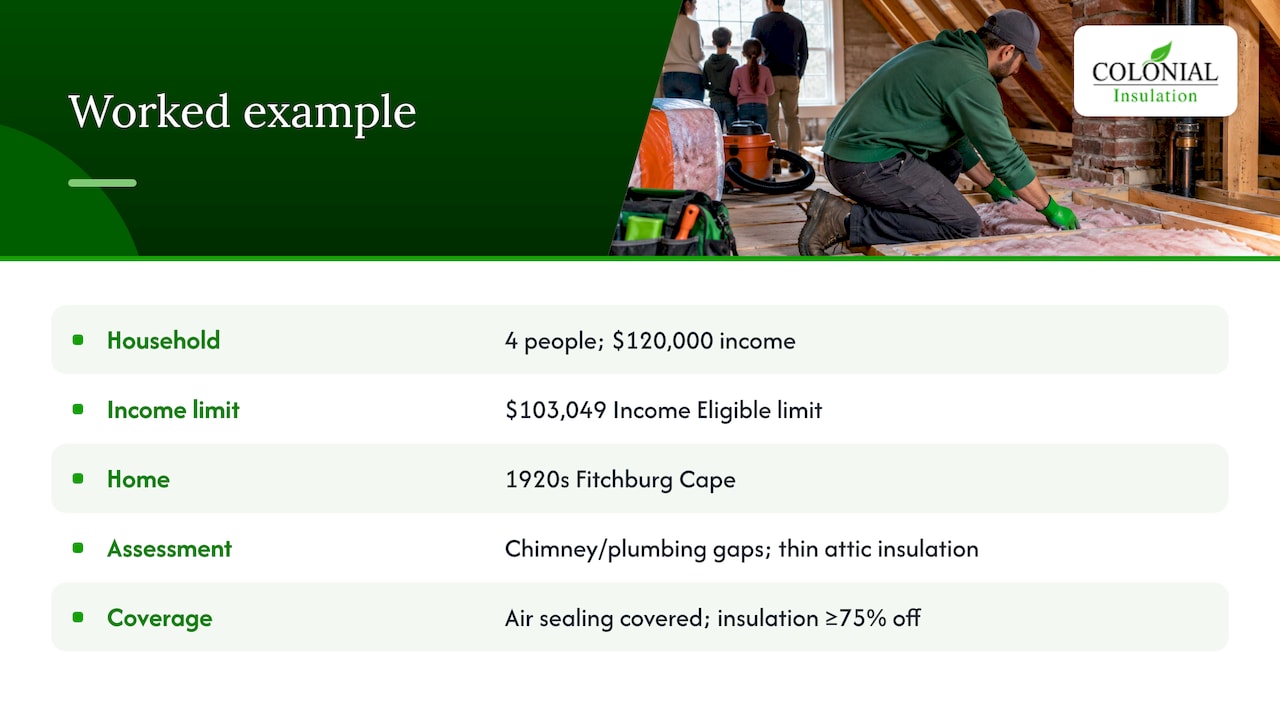
Take a four-person household in a 1920s Fitchburg Cape with a drafty attic and cold, uninsulated knee walls. The household income is $120,000, so it sits in the Enhanced Incentive range described above, not at the Income Eligible limit of $103,049.
An assessment finds open gaps around the attic chimney and plumbing chases and thin attic insulation. The recommended package is air sealing plus new attic insulation. Under the offers above, the air sealing is covered, and the insulation is discounted by at least 75%, possibly more depending on which tier applies. Whether the household’s tier pays 75% or 100% is the program’s call, not the contractor’s, so ask for the incentive level on every line of the written quote.
This example is illustrative and not a promise of what any house will receive.
Living in New Hampshire, Maine or Vermont
Mass Save only applies to Massachusetts utility customers. Most of our work is north of the border in New Hampshire, where the matching program is NHSaves. We are an NHSaves contractor and help New Hampshire homeowners access available energy efficiency rebates, and financing is available for insulation projects. Our overview of insulation rebates for New England homes covers how the state programs differ. If you are building or renovating in Massachusetts, our guide to Massachusetts insulation code requirements sets out what the walls and attic have to meet.
Getting the most out of the rebate
- Do the assessment first. The recommendations set which work gets the incentive.
- Air seal before you insulate. Insulation over leaky framing underperforms.
- Ask for incentive levels in writing. Each line should show the percentage and the amount deducted.
- Deal with barriers early. Wiring, vermiculite and moisture can stall a job, so find out about them at the assessment.
- Build in lead time. Demand has stretched timelines, so book before the cold months if you can.
- Re-check the terms before signing. Mass Save says offers can change.
How we help
We install spray foam, blown-in cellulose, mineral wool and fiberglass in attics, walls, basements and crawl spaces for homeowners across the Monadnock Region, southern New Hampshire and north-central Massachusetts. Our audits start with a blower door test and thermal imaging so the recommendation targets the leaks that are actually costing you. If you are in New Hampshire, we also help you access the NHSaves rebates that apply.
If you want to know where your house is losing heat before you decide, book a home energy audit with us.
FAQ
Is Mass Save legitimate?
Yes. Mass Save is the Massachusetts statewide efficiency program, run by a collaborative of utilities and gas companies including Eversource, National Grid, Unitil, Liberty, Berkshire Gas and Cape Light Compact. The assessment is no-cost, and you are not obligated to carry out any recommendation.
How long does a Mass Save rebate take?
Mass Save says rebates can take up to eight weeks. Online submissions through the Rebate Portal typically take 6 to 8 weeks, and mailed applications take longer. Insulation incentives are generally taken off the contract rather than mailed to you later.
Do I have to be low income to get an insulation rebate?
No. Income-eligible households and Designated Equity Community residents can receive 100% off, but others can still get 75 to 100% off approved insulation and no-cost air sealing, based on what the Home Energy Assessment recommends.
Does Mass Save cover homes in New Hampshire?
No. Mass Save serves Massachusetts. New Hampshire homeowners use NHSaves, and as an NHSaves contractor we help them access the rebates that apply to their project.
Sources
- Mass Save: Energy assessments, audits and equipment
- Mass Save: Insulation and air sealing
- Mass Save: Income Eligible Programs
- Mass Save: Income-based offers
- Mass Save: Designated Equity Communities
- Mass Save: Frequently asked questions
- Mass Save blog: New year, smarter energy choices
- Cape Light Compact: Insulation rebates and incentives
- Eversource: Home Energy Assessment
- National Grid: Income eligible services in Massachusetts
- City of Worcester: Smart Energy Advice
- Attic mold removal guide