
There is no federal insulation tax credit for work completed in 2027. The IRS says the Energy Efficient Home Improvement Credit, known as 25C, is not allowed for property placed in service after December 31, 2025. What still exists is a set of state, utility and federal rebate programs that pay for part of an insulation project, and in New England they are often worth more than the old credit was. We are Colonial Insulation, an NHSaves contractor in Rindge, New Hampshire, and this guide shows what ended, what is still available, and how to line up an insulation project so you capture whatever applies to your address.
TL;DR
- The 25C federal credit (30% of insulation material cost, up to $1,200 a year) ended for work placed in service after December 31, 2025. Nothing federal replaced it for 2027.
- Rebates, not tax credits, now carry the savings: utility-backed state programs such as NHSaves in New Hampshire and Mass Save in Massachusetts, plus federal home energy rebates that each state launches on its own schedule.
- A rebate usually depends on an assessment first, so the order of steps matters: audit, approved scope, then installation.
- Keep receipts, product labels and the audit report. You may need them for a rebate, a return or when you sell the house.
- If you insulated in 2025 and never claimed the credit, ask a tax professional about amending that year’s return.
Table of Contents
- What happened to the insulation tax credit
- What the old credit covered, in one worked example
- What still helps pay for insulation in 2027
- How the numbers compare
- Why the audit comes before the insulation
- Which material fits which job
- A sensible order for a 2027 project
- Records, and what to do about a 2025 project
- Builders and remodelers
- Get an insulation plan built around 2027 rebates
- FAQ
- Sources
What happened to the insulation tax credit
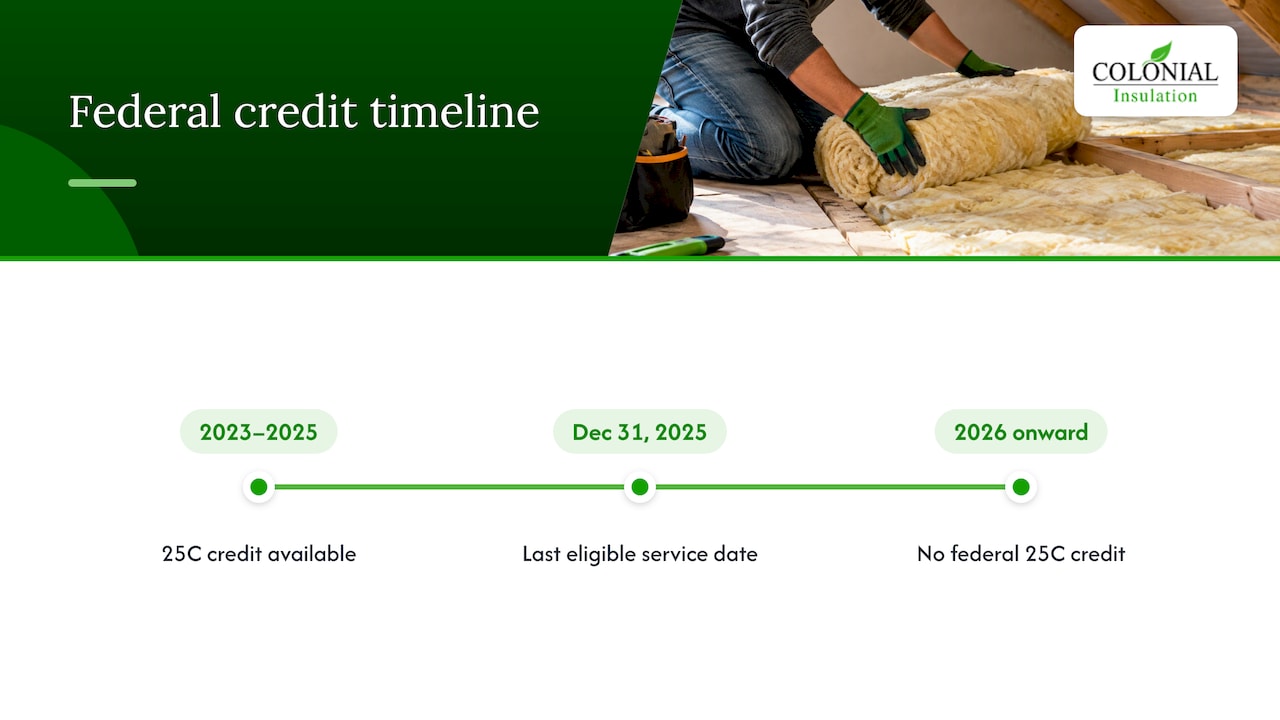
From 2023 through 2025, the 25C credit paid 30% of the cost of qualifying insulation and air-sealing materials, up to $1,200 per year. ENERGY STAR describes it as covering bulk products such as batts, rolls, blown-in fibers, rigid boards and expanding spray foam, along with air-sealing products. The home had to be your principal residence in the United States, and the credit sat inside an overall annual limit of $3,200 for efficiency upgrades.
The One Big Beautiful Bill Act, signed July 4, 2025, cut that schedule short. In its fact sheet on the law, the IRS confirms that 25C is not allowed for property placed in service after December 31, 2025. The test is when the insulation was installed and working, not when you signed a contract or paid a deposit. A job finished in January 2026 or later gets no federal credit, and neither does a job finished in 2027.
If you see a page promising a “2027 insulation tax credit,” it is either out of date or describing a state program. The federal one is closed.
What the old credit covered, in one worked example
It helps to know what you are comparing against. Say you paid $4,000 in 2025 for blown-in attic insulation: $2,200 for materials and $1,800 for labor. The credit applied to materials only, because installation labor did not qualify. Thirty percent of $2,200 is $660, and that came off your tax bill, not out of the contractor’s price. The credit was also nonrefundable, so it could only reduce tax you owed.
A utility rebate works differently. It usually reduces the invoice itself and often counts labor, which is why a project that earned a few hundred dollars in 2025 can earn far more through a state program in 2027.
What still helps pay for insulation in 2027
With the tax credit gone, three layers of help remain. Which ones you can use depends on your state, your utility and your household income.
Utility-funded state programs
These are ratepayer-funded programs run through your electric or gas utility. They are the largest source of insulation money in New England. A 2026 state-by-state rebate summary lists maximum insulation rebates of up to $6,000 in New Hampshire (NHSaves weatherization), $5,000 in Massachusetts (Mass Save), $8,600 in Maine, $7,000 in Vermont and $10,000 in Connecticut (Energize CT). Those are ceilings, not what every household receives.
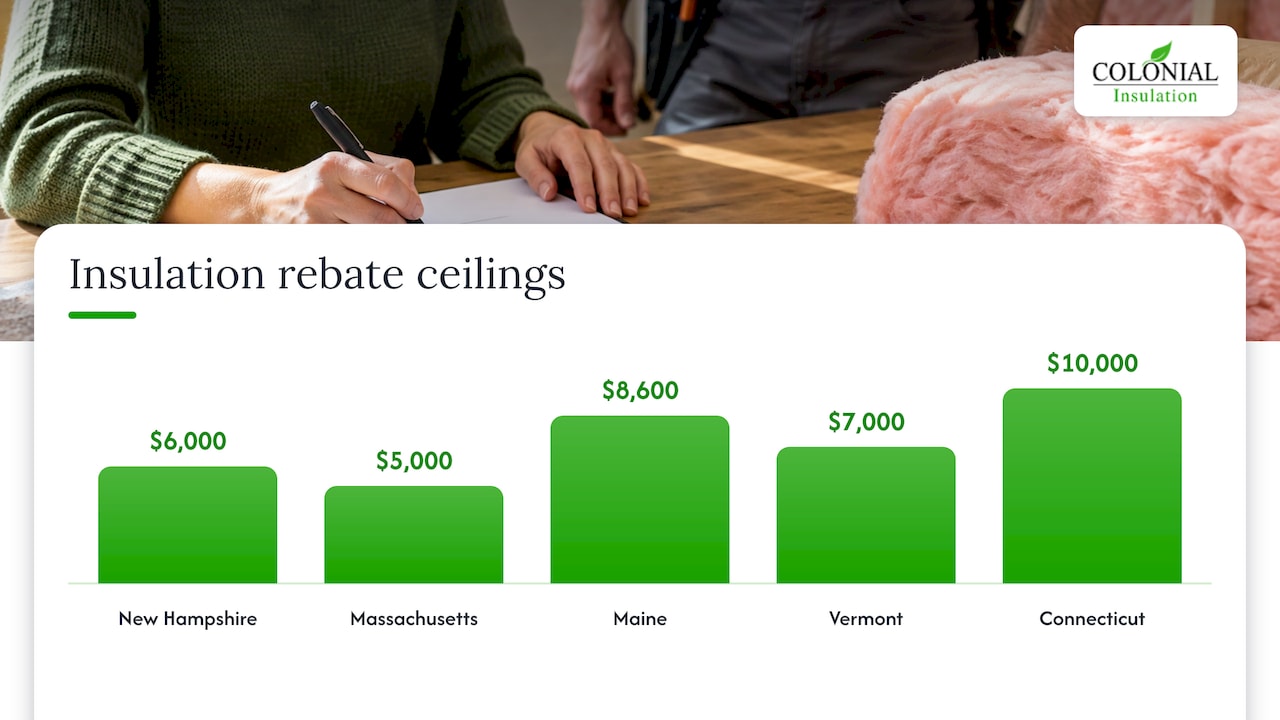
Connecticut shows how these programs are built. Energize CT’s 2026 insulation incentive pays up to $2.00 per square foot for professional installation, capped at $10,000, with enhanced amounts for income-qualified households. Program terms change from year to year, so read your own state’s page for the current numbers.
In New Hampshire, we are an NHSaves contractor and help homeowners access the rebates that apply to their project. Our page on insulation rebates for New England homes walks through how the programs fit together.
Federal home energy rebates
The Inflation Reduction Act funded two federal rebate programs that states administer. The Congressional Research Service summarizes them:
- HOMES pays for whole-home retrofits based on modeled energy savings. Rebates can reach $8,000 for low- or moderate-income households and $4,000 for other households that achieve at least 35% savings.
- HEAR is income-based. Households below 80% of area median income may receive up to 100% of project cost, and households at 80% to 150% may receive up to 50%, with a $14,000 household total. The cap for insulation, air sealing and ventilation is $1,600.
Congress appropriated the money and the Department of Energy oversees it, but each state energy office designs its own version. That is why the same federal program can be open in one state and still launching in the next. Income tiers, contractor requirements and start dates all differ. Check your state energy office’s page for its current status before you plan around these rebates.
Financing
When a rebate does not cover the whole project, financing spreads the rest out. We offer financing for insulation projects, and our guide to insulation financing for homeowners explains the options in plain terms.
How the numbers compare
| Old 25C credit (through 2025) | State utility programs (2026 figures) | Federal HEAR / HOMES rebates | |
|---|---|---|---|
| Available for 2027 work | No | Yes, where the program runs | Yes, where your state has launched it |
| How you receive it | Reduces your tax bill | Usually reduces the invoice | Rebate through a state program |
| Labor counted | No | Often yes | Depends on state design |
| Income limits | None | Enhanced tiers for lower incomes | Yes, tiered by area median income |
| Typical ceiling | $1,200 per year | Up to $5,000 to $10,000 across New England | $1,600 (HEAR insulation) or up to $8,000 (HOMES) |
Why the audit comes before the insulation
Rebate programs, and especially HOMES, are built around measured results. A program wants to know where your house loses heat and what the fix will save. That is also how you avoid insulating one area while air pours through another.
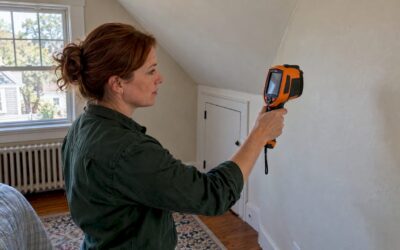
Our energy audits use blower door testing and thermal imaging. The blower door depressurizes the house to show how leaky it is, and the thermal camera shows where heat is escaping through walls, ceilings, rim joists and around chimneys. Then we recommend a fix. You can read what that looks like in what a home energy audit for insulation finds and see real thermal imaging audit examples.
In older New England houses the audit often points to the same few places:
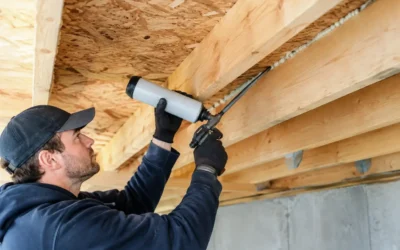
- Attic floors with thin or settled insulation. See our attic insulation services.
- Rim joists and basement walls where cold air enters. Our crawl space and basement insulation page covers this work.
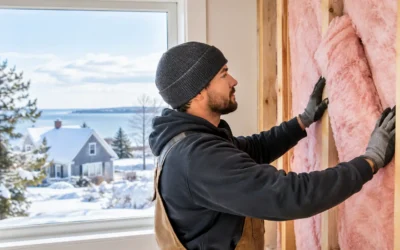
- Uninsulated wall cavities, which we address with wall insulation.
- Air leaks at penetrations and top plates, covered in our residential air sealing project guide.
Which material fits which job
Program rules mostly care about the result, so the material choice should follow the building. We install open-cell, closed-cell and HFO spray foam, blown-in cellulose, mineral wool and fiberglass.
- Blown-in cellulose is a common choice for attic floors and dense-pack walls. See cellulose insulation.
- Spray foam seals air leaks and insulates in one pass, which suits rim joists, cathedral ceilings and crawl spaces. See spray foam insulation.
- Mineral wool is a fit for areas where you want a batt that resists moisture. See mineral wool insulation.
If you are weighing two of them, our comparison of spray foam, blown cellulose and mineral wool in New England homes sets them side by side.
A sensible order for a 2027 project
- Find out what your utility offers. Look up your state program (NHSaves, Mass Save, Efficiency Maine, Efficiency Vermont or Energize CT) and your state energy office’s page on federal home energy rebates. Note whether an assessment is required first.
- Get an audit. Blower door and thermal imaging results give you a prioritized list instead of guesses.
- Settle the scope before work starts. Programs generally pay for work that was approved or qualifying at the time. Ask your contractor which measures are eligible and what paperwork is needed.
- Install, then collect the paperwork. Keep the invoice, the product specifications and the audit report.
- Apply for the rebate and plan for financing. If the rebate leaves a balance, financing covers the rest.
In New Hampshire, Massachusetts, southern Maine and Vermont we handle this kind of project every season, and as an NHSaves contractor we help New Hampshire homeowners access the rebates that apply to them.
Records, and what to do about a 2025 project
Rebates and old tax credits both leave a paper trail. The IRS advises keeping purchase receipts, installation records and product labels. You do not file them with your return, but you may need them if you are audited or when you sell the house and work out your cost basis. The credit itself was claimed on Form 5695, filed for the year the products were placed in service.
If your insulation was installed and functional by December 31, 2025, the 25C credit applies to your 2025 return, not your 2027 one. If you missed it, talk to a tax professional about whether amending that return makes sense. For anything involving your own tax situation, a CPA or enrolled agent is the right person to ask.
Builders and remodelers
If you build or renovate, the end of 25C changes less for you than for a homeowner. Your clients’ energy performance goals and local code still drive insulation specifications. Our guides to energy efficient construction in New England and Massachusetts insulation code requirements cover what to specify, and we work as an insulation subcontractor on new construction and renovations.
Get an insulation plan built around 2027 rebates
We install insulation and sealing for homes across the Monadnock Region, southern New Hampshire, north-central Massachusetts, southern Maine and Vermont. A good first step is a home energy audit: blower door testing and thermal imaging find the leaks and the thin spots, and we recommend the fix before any work is scheduled. As an NHSaves contractor, we help New Hampshire homeowners access available rebates, and financing is available.
Bring your latest utility bill and a list of the rooms that feel cold, and we will start there.
FAQ
Is there an insulation tax credit in 2027?
No. The federal 25C credit ended for property placed in service after December 31, 2025. Rebates from state utility programs and federal home energy rebates are what remain for 2027 projects.
Does insulation installed in 2026 or 2027 qualify for a federal credit?
No. The deciding date is when the insulation was installed and ready for use, not when you signed or paid. Work finished after 2025 is outside the credit, though it can still qualify for rebates.
How much can I get back on insulation in New England?
It depends on your state, utility and income. Published 2026 maximums range from about $5,000 in Massachusetts to $10,000 in Connecticut, with New Hampshire at up to $6,000, according to a state rebate summary. Those are ceilings, and the amount for your house depends on the scope of work and program rules.
Do I need an energy audit to get a rebate?
Many programs start with an assessment, and federal HOMES rebates are based on modeled energy savings, so an audit is the natural first step. Ours uses blower door testing and thermal imaging, so the recommendations are based on measured air leakage and heat loss.
Can I still claim the credit for insulation installed in 2025?
Yes, if the work was installed and functional by December 31, 2025, the credit belongs on your 2025 return using Form 5695. If you did not claim it, ask a tax professional about amending.
Sources
- Energy Efficient Home Improvement Credit, IRS
- IRS FAQs on the One Big Beautiful Bill Act changes to 25C and related credits
- Insulation Tax Credit, ENERGY STAR
- How to claim an energy efficient home improvement tax credit, IRS
- Residential Insulation Incentive Details, Energize CT
- The Inflation Reduction Act: Financial Incentives for Home Energy Efficiency, Congressional Research Service
- Insulation Rebates by State 2026