
Condensation on basement walls happens when humid air meets concrete that is colder than the air’s dew point. The fix is to control the moisture source and then build a wall that stays warm and can dry inward. In practice that means air sealing, foam against the foundation and a drainage check, in that order. We insulate basements across New Hampshire, Massachusetts, southern Maine and Vermont, and we start with a diagnosis, because insulating over a wet wall makes the problem worse.
TL;DR
- Summer condensation forms because basement walls are often colder than the dew point of the outdoor air that gets inside.
- A taped-down square of plastic or foil tells you whether the water comes from the air or through the wall. Both can happen at once.
- Fix the source first: gutters, grading, interior moisture. Then insulate with foam against the concrete so the wall can dry inward.
- Wet fiberglass or cellulose insulation must come out. Plastic sheeting under drywall is the wrong move.
- We can assess your basement with blower door testing and thermal imaging before recommending a fix.
Table of Contents
- Why basement walls sweat
- Condensation or a leak? A simple test
- Fix the moisture source first
- What insulation does for a sweating wall
- Which insulation works against a foundation wall
- If the insulation behind the wall is already wet
- Why a diagnosis comes before the insulation
- FAQ
- Sources
Why basement walls sweat
A below-grade concrete wall is in contact with the ground, so it stays cool all summer. Warm, humid air drifts in through windows, gaps and the rim joist area. When that air touches the cool surface, it drops below its dew point (the temperature at which air can no longer hold its water vapor) and turns to liquid. UMN Extension describes the same pattern: outside humid air enters the basement and condenses on cooler walls and floors.
The foundation is also a steady moisture source. Researcher Patrick Huelman, summarized in a DOE Building America guide, notes that foundations get wet from three sides and can only dry to the inside. The same guide cites research finding that poorly drained and sealed slabs, basement walls and crawl spaces can contribute as much as 50% of a home’s interior moisture load.
That is why New England basements are so prone to it. Cold ground, humid summers and older, leaky foundations all push in the same direction. Our New England humidity insulation guide covers how the regional climate plays into this.
Signs the humidity is too high
Beads of water are only one sign. UMN Extension lists these others:
- A damp, musty smell, mold and mildew
- Deteriorating carpet or wood, and rot in joists, sill plates or columns
- Stained or blistering wall coverings
- White crust (efflorescence) or flaking on concrete and masonry
The DOE guide gives 35% to 50% relative humidity as the ideal range for a home, and says visible condensation on cold wall surfaces signals high humidity.
Condensation or a leak? A simple test
The two look alike and are fixed differently. Here is the field test most building pros use:
- Choose a bare section of wall with no paint problems you can’t explain. Dry it off.
- Tape a square of clear plastic, roughly 1.5 feet on a side, tightly to the wall. Seal all four edges. (True Value describes a similar test with foil.)
- Leave it at least 24 hours, ideally through humid weather.
- Check which side is wet. Moisture on the room side means condensation. Moisture between plastic and wall means a leak. Both sides wet means both are happening.
Other clues: condensation shows up evenly on cold pipes, windows and walls in muggy weather. Leaks concentrate at cracks, joints and the wall-floor line during or after rain.
If water appears near plumbing or the floor stays damp in dry weather, a water meter no-use test can rule out a hidden pipe leak: shut off every fixture and watch the meter for 15 to 30 minutes. If you see active seepage, our page on water in your basement walks through first steps.
Fix the moisture source first
UMN Extension’s advice is to remove or control the source rather than stop moisture at the last line of defense, and to work from the cheapest step upward. In order:
- Cut indoor moisture. Vent dryers and bathrooms outdoors and remove sources like unvented fuel heaters or drying laundry.
- Don’t ventilate with humid summer air. Opening basement windows in July brings in exactly the air that condenses.
- Fix exterior water. Clean gutters, extend downspouts and re-slope soil away from the foundation. One published guide puts this work at $0 to $200, and says to do it before pricing any drainage system.
- Drainage if needed. UMN Extension suggests an interior or exterior drainage system with airtight sump covers if the problem persists.
- Dehumidify. A dehumidifier helps with comfort, but UMN Extension says it is not a permanent solution. See our guide to basement dehumidification in New England homes.
When the problem is seepage, our basement water sealing and encapsulation service is the route we offer.
What insulation does for a sweating wall
Warming the wall surface is the direct cure for summer condensation. Insulation keeps the concrete’s interior face closer to room temperature and, if it is airtight, keeps humid air from touching cold concrete at all. The upper part of the wall matters most: DOE notes that leaving the above-grade and at-grade portions uninsulated exposes them to the coldest temperatures, and condensation and ice can form on the inside of that wall.
Rim joists, the wood band on top of the foundation, are a special case. Building Science Corporation’s Betsy Pettit explains that they are cold in both summer and winter, which is why interior assemblies must be as airtight as possible. We cover the details in how to insulate rim joists in New England homes.
Which insulation works against a foundation wall
The type matters because the wall needs to dry inward. Building Science Corporation says the best basement wall insulations are foam-based and allow that drying. Its guidance lists these thicknesses as meeting the vapor permeance requirements: up to 2 inches of unfaced XPS, 4 inches of unfaced EPS, 3 inches of closed-cell spray foam (R-18) and 10 inches of open-cell spray foam.
The DOE Building America recommended assembly runs like this:
- Foam board or closed-cell spray foam, at least 1 inch, against the concrete as a capillary break and air barrier
- Furring strips or a stud wall, with uncompressed fiberglass batts if you want more R-value
- Moisture- and mold-resistant gypsum board held 1/2 inch above the floor
- Two coats of latex paint
The source is the DOE assembly guidance, which also says not to put plastic sheeting under the drywall. ENERGY STAR prohibits Class I vapor retarders (very low permeability, such as polyethylene) on the interior side of air-permeable insulation in below-grade exterior walls. Huelman also reported finding no research supporting fibrous insulation directly against the interior of basement walls without a risk of condensation on interior surfaces.
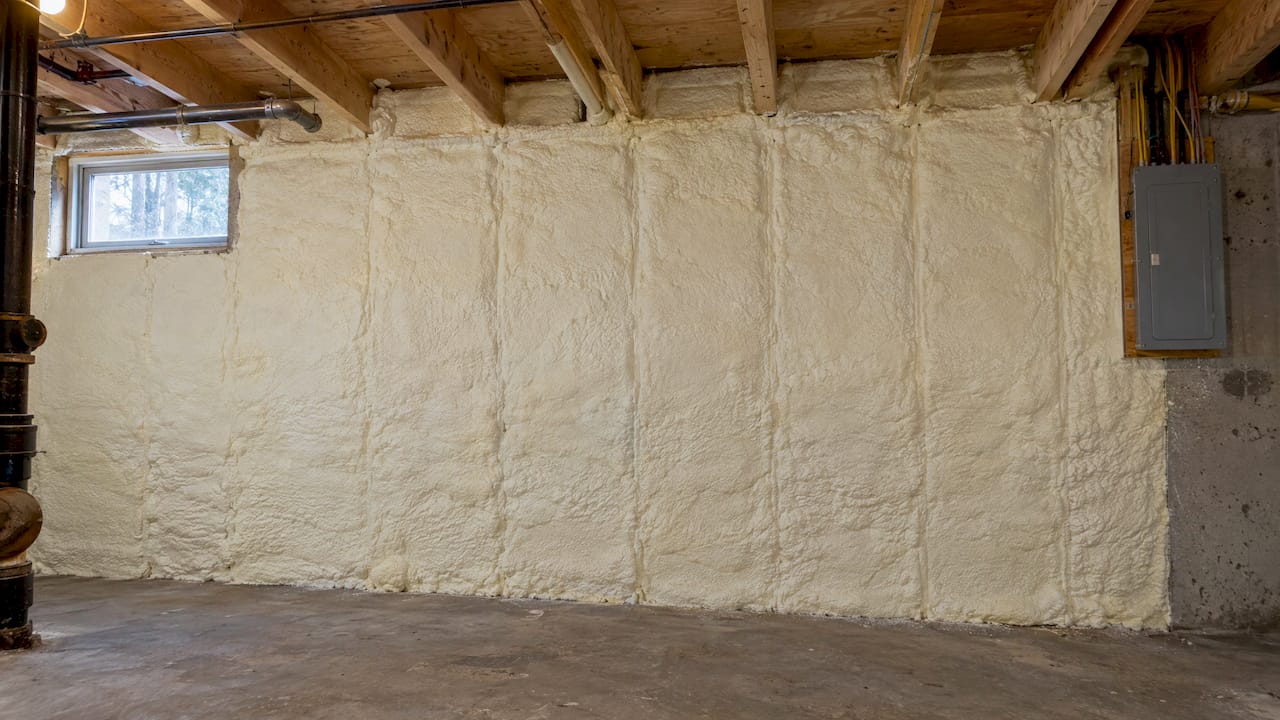
This is where spray foam earns its place. Applied directly to the concrete, closed-cell foam seals the wall against air and moisture vapor in one layer. Our spray foam insulation crews install open-cell, closed-cell and HFO foam. For regional context, see vapor barrier placement for New England homes and our moisture-resistant basement insulation guide.
Worked example: a 1920s stone-and-concrete basement
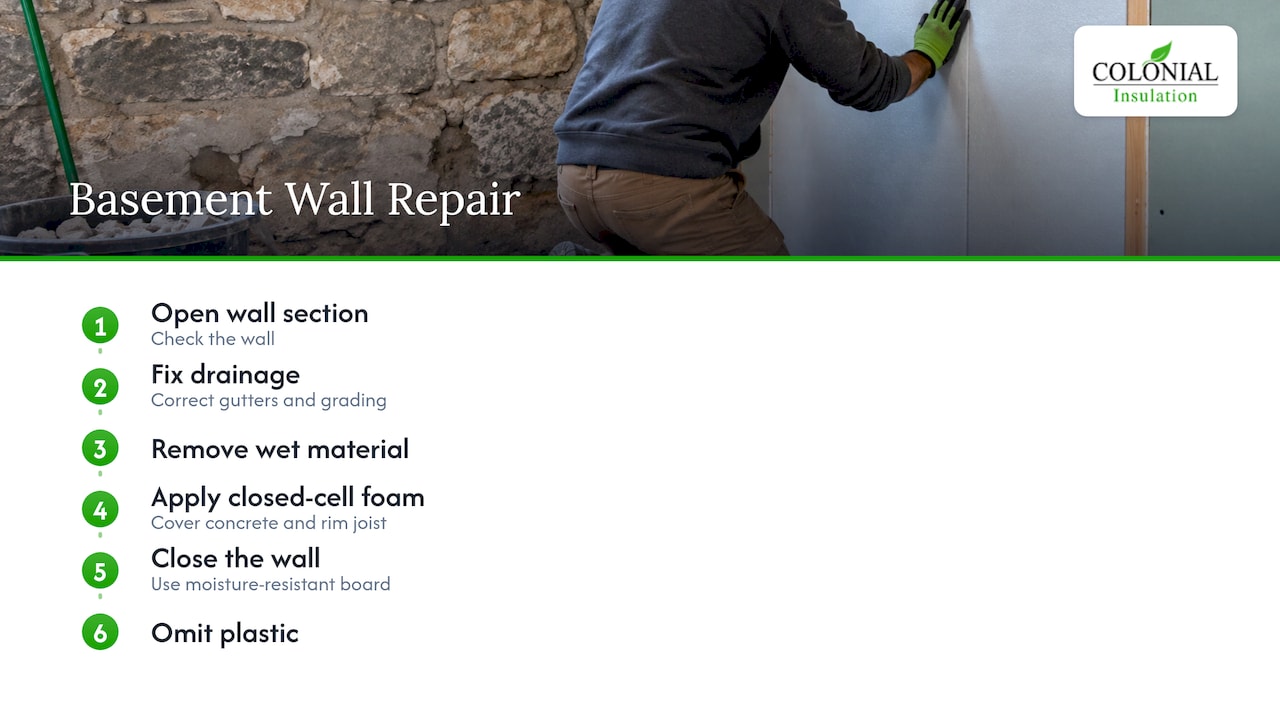
Say a New Hampshire basement has beaded walls every July, a musty smell and a finished stud wall with fiberglass batts and plastic behind the drywall. The plastic and batts are the problem: humid air reaches cold concrete behind them and has nowhere to dry. The sequence is to open a section, check the wall, fix gutters and grading, remove wet material, spray closed-cell foam on the concrete and rim joist, then close the wall with moisture-resistant board. The plastic stays out.
If the insulation behind the wall is already wet
Wet insulation does not dry reliably once it is enclosed. DOE’s Home Improvement Expert fact sheet says that if inspection finds moisture in basement wall cavities, the drywall and existing insulation should come out and the source be fixed before insulating with spray foam or rigid foam.
DOE’s homeowner repair guide adds specifics:
- Soaked fiberglass batts and cellulose must be removed and discarded. Rigid foam can be washed and kept.
- Wet framing can stay if it dries naturally and is not damaged.
- Wood should be below 20% moisture content and drywall or plaster below 2% before it is covered again.
Mold on wet materials is a health concern. If someone in your home has asthma or a mold allergy, have the affected area handled by a qualified remediation professional before any insulation work.
Why a diagnosis comes before the insulation
Most failed basement insulation jobs are skipped diagnoses: a wall that was leaking got covered, or condensation got treated as a leak. We pair the work with home energy audits that use blower door testing and thermal imaging to find air leaks and heat loss before recommending a fix. That tells you where humid air gets in and which parts of the foundation are coldest, and it shapes the scope.
From there we can handle the full job: basement insulation, crawl space and basement insulation, and sealing or encapsulation where water is the issue. In New Hampshire, we are an NHSaves contractor and can help you access available energy efficiency rebates, and financing is available. Our approach is laid out on the basement insulation moisture control page.
To start with an assessment of your basement, see our home energy audits.

FAQ
What month should you run a dehumidifier in your basement?
Run it whenever humidity climbs above the 35% to 50% range DOE gives as ideal, which in New England is mostly late spring through early fall. Use a humidity meter to decide rather than the calendar. Treat the dehumidifier as a comfort tool alongside fixing the source.
Is condensation on basement walls normal?
It is common in humid weather because cold walls meet warm air, but it is a sign the basement has too much moisture or air leakage. Repeated condensation can lead to mold, rot and damaged finishes, so it is worth fixing rather than wiping up.
Can I put insulation over a damp basement wall?
Not until you know the source. Confirm whether it is condensation or a leak, correct drainage, remove any wet material and then insulate with foam against the concrete. Covering a wet wall traps the moisture.
Should I use plastic sheeting behind basement drywall?
No. ENERGY STAR prohibits Class I vapor retarders such as plastic sheeting on the interior side of air-permeable insulation in below-grade exterior walls. Foam against the concrete, with a wall that can dry inward, is the approach DOE recommends.
Sources
- Moisture in basements: causes and solutions, UMN Extension
- Managing Indoor Humidity and Ventilation in Cold Weather, DOE Building America
- Moisture in the home, Barron County, Wisconsin
- Condensation on Basement Walls, or a Leak? How to Tell
- Water in Basement? Find the Source of Leaks, True Value
- How to Detect Water Leaks in Your Basement
- Basement Waterproofing Systems Compared
- Air Sealed, Insulated Basements, DOE Building America
- Info-511: Basement Insulation, Building Science Corporation
- No Vapor Retarders on Interior Side of Air-Permeable Foundation Insulation
- DOE Home Improvement Expert Fact Sheet and Checklist
- Repairing Walls & Floors: How To’s for the Handy Homeowner, DOE