
Most New Hampshire homeowners should plan on roughly $1 to $2.50 per square foot installed for blown-in attic insulation, which puts a typical attic between about $1,000 and $5,500 depending on size, existing insulation and air sealing. The wide spread comes from the job, not the material. An attic that needs air sealing, old insulation removal and a jump to the R-49 target costs far more than a simple top-up. A site visit with diagnostics gives you a real number. Our home energy audits use blower door testing and thermal imaging to find air leaks and heat loss before we recommend a fix, so the quote matches what your house needs.
TL;DR
- Published New Hampshire estimates for blown fiberglass and cellulose cluster around $1.10 to $2.90 per square foot installed, with a 1,000 sq ft attic often landing between about $1,000 and $2,900.
- Total project cost is driven by R-value target, air sealing, removal of old material, attic access and labor, not by the bag price alone.
- New Hampshire sits in climate zone 6, where R-49 is the usual attic target, and many older homes have far less.
- NHSaves rebates can offset part of the cost, but they require a participating contractor and are not available for DIY work.
- Blown-in wall insulation costs more per square foot than attic loose fill because the work is slower and includes patching.
Table of Contents
- What blown-in insulation costs per square foot in New Hampshire
- What a typical New Hampshire attic costs
- What moves the price up or down
- What blown-in wall insulation costs
- How to compare estimates fairly
- Rebates that can lower the bill
- Is it worth the money?
- Why a diagnostic visit gives you a better number
- Get your attic priced
- FAQ
- Sources
What blown-in insulation costs per square foot in New Hampshire
Blown-in (also called loose-fill) insulation is cellulose or fiberglass fibers blown by machine into an attic floor or enclosed wall cavity. Contractors price it per square foot of area covered, with the R-value (resistance to heat flow) as the main variable.
No single figure is authoritative, so it helps to see several published estimates side by side. These come from cost-modeling sites and are published for their stated periods, not as quotes:
| Source and period | Blown fiberglass | Blown cellulose |
|---|---|---|
| Insulation Cost Calculator, NH guide updated October 2026 | $1.10 to $2.09 per sq ft | $1.21 to $2.20 per sq ft |
| BuildCost, October 2026 NH attic model | $1.20 to $2.55 per sq ft | $1.38 to $2.90 per sq ft |
| Typical Costs, 2026 NH range | $0.90 to $2.00 per sq ft (blown-in, both materials) |
For context, the national picture is similar. TradeProven’s 2026 guide puts blown-in insulation at $1.00 to $2.50 per square foot installed, with most homeowners near $1.75. It also notes that cellulose runs slightly more per square foot than fiberglass because it offers more R-value per inch.
A lower outlier exists. CostPrism’s June 2026 New Hampshire data prices a 1,200 sq ft blown-in attic at about $1,210, which is about $1.01 per square foot. That is the kind of figure you get for a simple top-up on an easy attic with no air sealing. It is a floor for the cheapest scenario, not a planning number for an older house.
The federal energy lab data point is a useful anchor. According to NREL’s REMDB 2024 figures (in 2023 dollars), installed attic loose fill at R-49 runs $1.02 to $2.13 per square foot, with a median of $1.83. Loose fill had the lowest median installed cost of any attic-floor insulation it prices.
What a typical New Hampshire attic costs
Multiply the per-foot range by your attic floor area and you get a first estimate. For a 1,000 sq ft attic, the ranges above translate to roughly $900 to $2,900 for the insulation work alone.
Published totals for whole projects are wider, because they fold in extras:
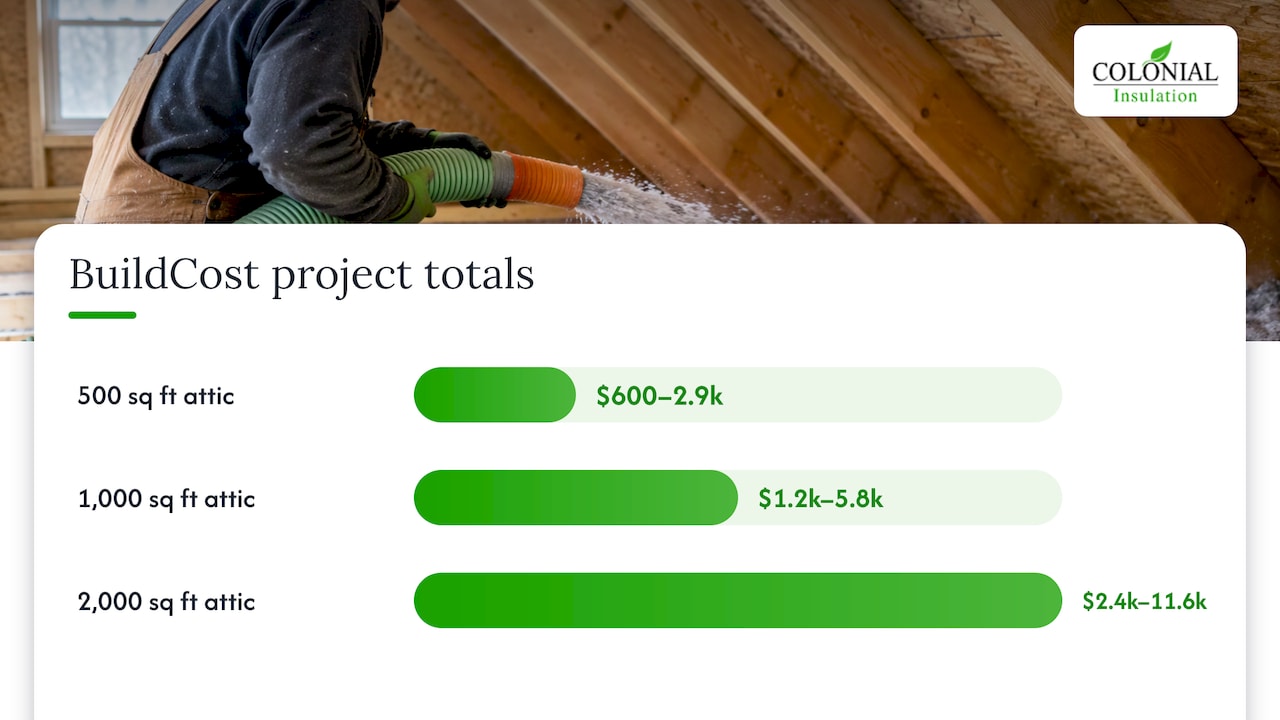
- BuildCost’s October 2026 estimate for a 1,000 sq ft New Hampshire attic is $1,200 to $5,800, averaging $2,400. Its 500 sq ft example runs $600 to $2,900, and its 2,000 sq ft example $2,400 to $11,600.
- ClearCost’s April 2026 guide shows a 1,000 sq ft blown-in attic floor at $850 to $2,650, and says New Hampshire insulation runs about 6% above the national average.
- UseCalcPro’s March 2026 state comparison puts an average New Hampshire attic project (1,000 sq ft of blown fiberglass to R-49 or R-60) at $3,100, about 24% above the $2,500 national average. It credits higher R-value requirements in climate zones 5 and 6, plus higher labor rates.
- For a 1,200 to 1,600 sq ft attic with air sealing and blown-in cellulose or fiberglass to R-49, RoofVista’s April 2026 New Hampshire guide cites $2,500 to $5,500 installed.
The honest takeaway: a typical single-family New Hampshire attic, done properly with air sealing, is a low-to-mid four-figure project. A bare-bones top-up can be less. A large attic with removal and repairs can run higher.
What moves the price up or down
The same square footage can produce quotes that differ by thousands of dollars. These are the reasons.
Target R-value
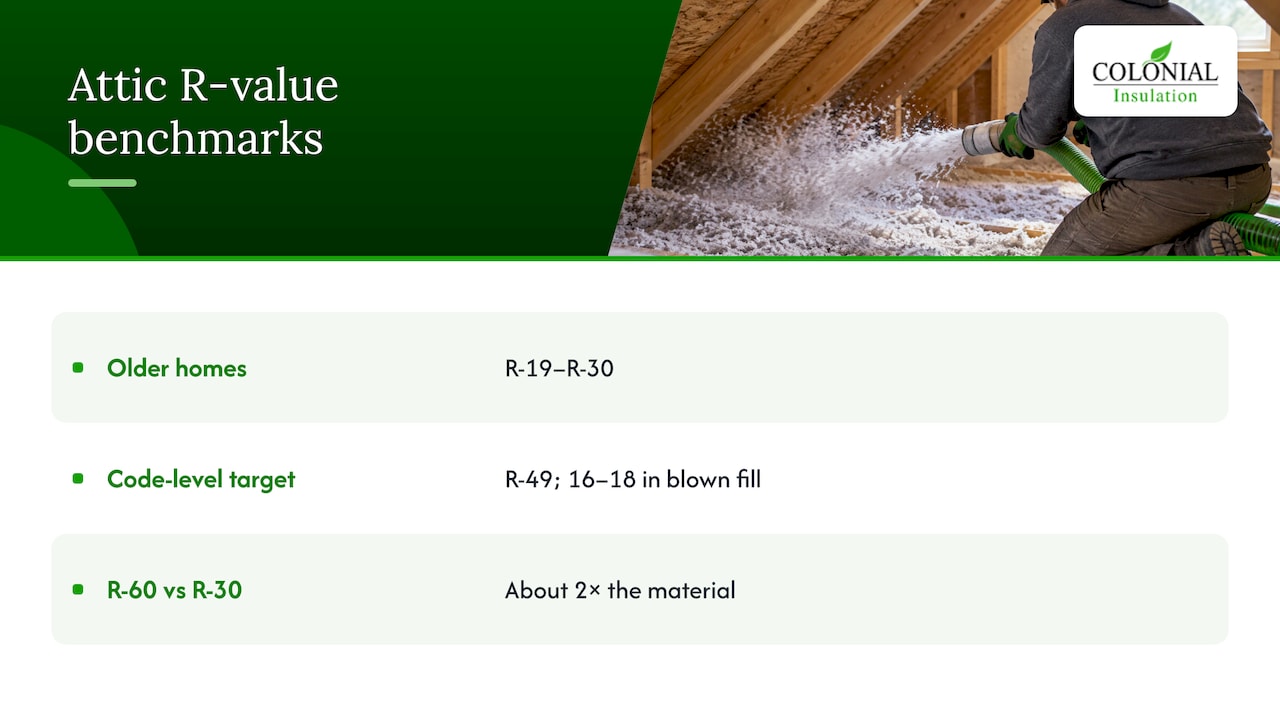
R-value is how well insulation resists heat flow. It is the single biggest driver of material quantity: UseCalcPro’s analysis notes that R-60 needs roughly twice the material of R-30. New Hampshire is in climate zone 6, and RoofVista’s guide describes R-49 as the code-required attic level, about 16 to 18 inches of blown cellulose or fiberglass, noting that many older homes have only R-19 to R-30. Going from R-19 to R-49 means a lot more fiber than topping up from R-38. Our guide to what R-value your attic needs in New England walks through the target.
Air sealing
Air sealing means closing the gaps where heated air escapes into the attic: recessed lights, wiring and plumbing penetrations, the attic hatch and the tops of walls. ENERGY STAR’s attic guidance recommends sealing the attic before adding insulation. Pricing varies: Bob Vila’s cost guide says air sealing can add $350 to $1,500, and BuildCost estimates $250 to $750 for it.
This is money well spent. RoofVista reports that blown-in material over unsealed leaks can lose 30 to 50% of its effectiveness. We explain the reasoning in why air sealing matters before adding insulation, and our residential air sealing project guide shows what the work covers.
Removing old insulation
If existing insulation is wet, moldy or contaminated, it may need to come out first. BuildCost estimates removal at an additional $1 to $2 per square foot. Our article on when to replace old attic insulation covers the signs.
Access and attic condition
Tight hatches, low rafters, a lot of stored belongings and complicated framing all add labor. ENERGY STAR also advises checking for wet insulation, mold or rot, improperly vented fans, poor ventilation and knob-and-tube wiring before work begins. Problems found there get fixed first, and that is a cost to expect rather than a surprise.
Material: cellulose or fiberglass
The two materials are close in price, with cellulose usually a bit higher per square foot in the estimates above. Cellulose is dense, recycled-content fiber that packs well around obstructions. NREL’s pricing treats them under one loose-fill category. Our comparison of cellulose versus fiberglass and our guide to the best attic insulation materials for New England help you choose for your attic.
What blown-in wall insulation costs
Walls are a different job. Instead of spreading fiber across an open attic floor, the installer fills closed cavities through small holes and then patches them. That is slower, and the price shows it.
HomeWyse’s May 2026 calculator estimates basic blown-in wall insulation at $3.81 to $4.66 per square foot nationally, including labor, equipment, supplies and patching under favorable site conditions. Expect New Hampshire’s older houses, with uneven framing and previous modifications, to need a site visit before anyone can commit to a number. If you are weighing walls, see our wall insulation service.
How to compare estimates fairly
Two quotes for the same attic can look 40% apart and still describe different jobs. Line them up on these points:
- Target R-value and depth. Both quotes should state the final R-value, not just “add insulation.”
- Air sealing. Is it included, and what is sealed? Without it, you are paying for insulation that underperforms.
- Removal and prep. Does the price include removing old material, baffles for ventilation and covering or protecting the attic hatch?
- Itemization. HomeWyse recommends itemized assessments and notes that its basic estimate excludes unmentioned work, system modifications, hazardous-material testing and remediation, general-contractor markup, sales tax, and permit or inspection fees.
- Rebate handling. Ask who files the paperwork and whether the contractor participates in the utility program.
HomeWyse also says its calculator is an educational baseline for favorable conditions and not a substitute for a written local estimate, which is exactly why a measured, itemized quote matters.
Rebates that can lower the bill
New Hampshire’s utility efficiency program, NHSaves, is the main source of help for insulation. A weatherization FAQ from the town of Hanover states that NHSaves rebates up to $4,000 are available, subject to fuel-use-per-square-foot eligibility and first-come, first-served availability. Terms change, so check the current program rules before you sign anything.
RoofVista’s guide adds that NHSaves rebates require work by a participating contractor, so DIY blown-in jobs do not qualify. We are an NHSaves contractor and help New Hampshire homeowners access available energy efficiency rebates, and financing is available for insulation projects.
Households with lower incomes have another route. The New Hampshire Department of Energy’s Weatherization Assistance FAQ says households up to 60% of state median income may qualify for weatherization services. Owners and tenants may qualify, with priority for disabled and elderly people, households with children under six and those with the highest energy costs. The same FAQ lists an average program cost of $6,500 per unit served, which is a program figure, not a quote for your home.
ENERGY STAR adds that many local utilities may offer rebates for professional home energy assessments and qualifying air-sealing or insulation projects, and recommends checking with the utility before starting work. If you also own property in Massachusetts, our page on the Mass Save insulation rebate covers that state’s program.
Is it worth the money?
Payback depends on what you have now and how you heat. One modeling site, CostlyHome (updated September 27, 2026), estimates a 4.0-year payback for insulating a bare 1,200 sq ft New Hampshire attic to R-49, and 29.0 years for a top-up from R-19. Those figures rest on its stated assumptions, including a gas furnace and the national gas price. It says savings vary with existing insulation, energy prices and heating fuel, and that air sealing first usually improves results.
The pattern is clear: the less insulation you have, the faster the upgrade pays back. Comfort gains, fewer cold rooms and less ice-dam risk come on top of the energy numbers. To see where your own home falls, start with how to calculate your home’s insulation needs.
Why a diagnostic visit gives you a better number
Every published range above is wide because it averages houses nobody has measured. The way to narrow it is to measure yours. Our energy audits use a blower door, which depressurizes the house to expose air leaks, and thermal imaging, which shows where heat is escaping. We use these before recommending a fix, so the scope of air sealing, the right R-value and the choice between cellulose, fiberglass, mineral wool or spray foam come from your house rather than a rule of thumb. Blower door testing is also how you can confirm the house is tighter afterward.
If blown-in is not the best fit for a particular space, such as a rim joist, crawl space or cathedral ceiling, the same visit identifies that. Our spray foam insulation and mineral wool services cover those cases.
Get your attic priced
We install blown-in cellulose and fiberglass in attics and walls for homeowners and builders across New Hampshire, southern Maine, Vermont and north-central Massachusetts, from the Monadnock Region to Nashua and Manchester. We are BBB A+ accredited and a member of the New Hampshire Home Builders Association.
If you are ready for a number tied to your own attic, see our attic insulation services or our cellulose insulation page, or book an energy audit to find out what your house needs first.
FAQ
How much does it cost to blow insulation into an attic in NH?
Published 2026 estimates run about $0.90 to $2.90 per square foot installed, so a 1,000 sq ft attic is roughly $900 to $2,900 for insulation alone. With air sealing, removal and a high R-value target, whole-project estimates reach $2,500 to $5,500 for a typical New Hampshire attic. An on-site assessment is what turns a range into a quote.
How much does it cost to get insulation blown into walls?
HomeWyse’s May 2026 national estimate for basic blown-in wall insulation is $3.81 to $4.66 per square foot, including labor, equipment, supplies and patching. Walls cost more than attics because cavities are closed and need drilling and patching. Older New Hampshire homes often need a site visit to price accurately.
How much blown-in insulation does an attic need?
New Hampshire is in climate zone 6, where R-49 is the usual target, which is about 16 to 18 inches of blown cellulose or fiberglass according to RoofVista’s guide. The right depth depends on what is already there and the material used. Air sealing first makes every inch work harder.
Is blown-in insulation worth it?
For homes with thin or no attic insulation, usually yes. CostlyHome’s model estimates a 4.0-year payback for a bare attic, though results depend on heating fuel, energy prices and existing insulation. Rebates through NHSaves can lower the upfront cost when a participating contractor does the work.
Sources
- Blown-In Insulation Cost in New Hampshire, Typical Costs
- Insulation Cost in New Hampshire (2026), Insulation Cost Calculator
- Attic Insulation Cost in New Hampshire (2026), BuildCost
- Blown-in insulation cost guide 2026, TradeProven
- Insulation Cost in New Hampshire 2026, CostPrism
- Cellulose Insulation: R-Value, Cost, Pros and Cons
- Insulation Installation Cost in New Hampshire (2026), ClearCost
- Average Insulation Cost by State in 2026, UseCalcPro
- Ice Dam Prevention in New Hampshire 2026, RoofVista
- Attic Insulation Project, ENERGY STAR
- How Much Does Blown-In Insulation Cost to Install?, Bob Vila
- Cost to Install Blown-In Wall Insulation, HomeWyse
- Insulation Cost and Payback by State, CostlyHome
- Weatherization Assistance FAQ, NH Department of Energy
- Weatherization FAQ, Town of Hanover