
Water in a basement has a source, and the fix depends on finding it: rain pooling against the foundation, groundwater pushing up through the slab, humid air condensing on cold concrete, or a pipe or sewer problem. Handle the safety steps first, dry everything within 24 to 48 hours, then have the source dealt with properly. For seepage through walls and floors, that means sealing and encapsulating the basement, which is what we do at Colonial Insulation for homes across New Hampshire, Massachusetts, southern Maine and Vermont.
TL;DR
- Stay out of a basement with standing water until the electricity, gas and structure are safe. Then stop the source, document the damage and dry the space within 24 to 48 hours if possible.
- Where the water shows up tells you a lot: along the wall and floor joint after rain points to groundwater pressure, a damp floor with no puddle often points to condensation or moisture moving through the slab, and water at a floor drain can mean a sewer backup.
- Standard homeowners policies generally do not cover seepage through basement walls or floors, so a permanent fix is the real protection.
- Gutters, downspouts and grading reduce the load on your foundation, and basement water sealing and encapsulation deal with the moisture that still gets in.
Table of Contents
- What to do in the first hour
- Finding where the water comes from
- Why your basement leaks when it rains
- Why the floor is wet when nothing is leaking
- Does homeowners insurance cover basement water?
- Stopping water at the source
- Sealing and encapsulating the basement
- Get your basement looked at
- What to check before and after any basement repair
- FAQ
- Sources
What to do in the first hour
The first priority is not the water. It is the electricity. A basement with standing water can hide live wiring, and the MMSD guidance on water in the basement is blunt: do not enter a basement with standing water, call your homeowners or renters insurance agent, and either wait for the water to drain or have a qualified electrician disconnect the power before you go in.
If the water is shallow or gone and you can get in safely, MU Extension advises turning off electricity and gas, checking the outside basement walls for cave-ins or structural damage, and opening doors and windows for ventilation. If you plan to pump water out, check with your insurer first.
Here is a sensible order of work once the space is safe:
- Cut the power and gas to the affected area. If you cannot reach the panel without wading, call an electrician.
- Stop the source if it is one you can stop, such as a burst supply line or an overflowing washing machine hose.
- Document everything with photos and video before you move or throw anything away, and call your insurer.
- Pump out gradually. MU Extension suggests pumping out about 1 foot of water, marking the new level, waiting overnight and repeating daily. Pulling the water out too fast can put pressure on walls that are still surrounded by saturated soil.
- Remove wet items and extract what is left with a wet-dry vacuum.
- Move air. Fans and a dehumidifier help, as American Family Insurance lays out for the first 24 hours after a flood.
The clock matters. State Farm’s flooded basement guide notes that the EPA recommends cleaning and drying the home and belongings within 24 to 48 hours if possible, because materials that stay wet longer are more likely to develop mold.
If the water came up through a floor drain, treat it differently. That is usually a sign of a sewer backup, and it is not groundwater. Report it to your municipal public works or sewer department, and do not use the water in the house until you know the line is clear.
Finding where the water comes from
Basement water problems look similar but have different causes. UMN Extension sorts the sources into three groups: liquid water from rain or groundwater, moisture made inside the house (humidifiers, unvented dryers, bathrooms, cooking), and humid outdoor air that enters and condenses on cooler surfaces.
A county homeowner manual from Prince George’s County, Maryland breaks liquid-water problems into five common causes: a break in a water line or other plumbing problem, direct inflow of surface water, surface water infiltration, groundwater infiltration, and a blocked stairwell or areaway drain or sewer backflow.
Use the pattern of the water to narrow it down:
| What you see | Most likely source | What it suggests |
|---|---|---|
| Water at the wall and floor joint during or after rain | Surface water or rising groundwater | Drainage outside, and pressure on the foundation |
| Water through a single wall during heavy rain | Surface water infiltration, often near a downspout or low grade | Roof water and grading |
| Damp floor and walls, no puddle, worse in warm humid weather | Condensation or vapor moving through concrete | Humidity control and a moisture barrier |
| Water at the floor drain | Sewer lateral or public sewer backup | Municipal or sewer line problem |
| Water that appears regardless of weather | Plumbing leak | A broken line or fixture |
The sewer question has a simple test. MMSD explains that if the weather has been dry and you are running water in the house, a blocked lateral is the likely cause and the backed-up water is your own. If it is raining and your neighbors have backups at the same time, the public sewer is probably full and pushing water into your lateral.
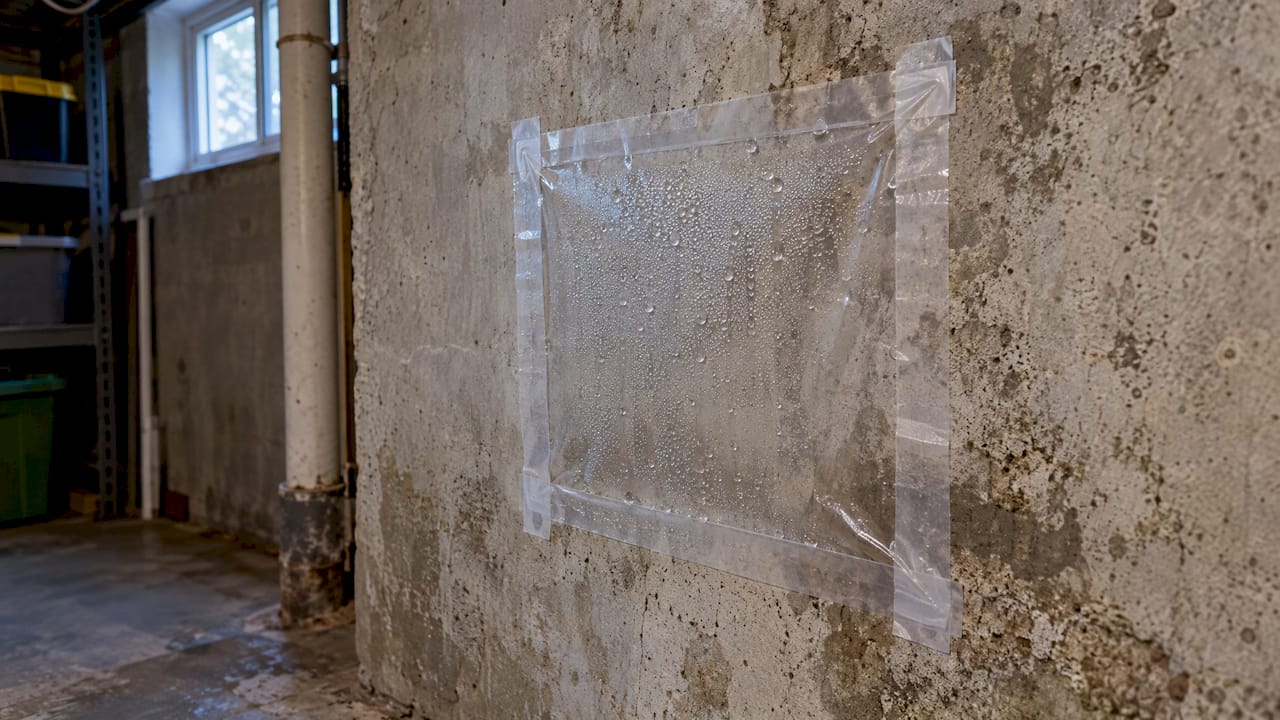
The plastic sheet test for damp walls and floors
When the surface is damp but you cannot find a leak, tape a square of plastic, roughly 12 by 12 inches, firmly to the wall or floor and leave it for 24 to 48 hours. Moisture on the room side of the plastic points to condensation from humid air. Moisture trapped behind it means water is moving through the concrete or masonry. It is a quick way to learn whether you have a humidity problem or a seepage problem before anything gets spent.
Why your basement leaks when it rains
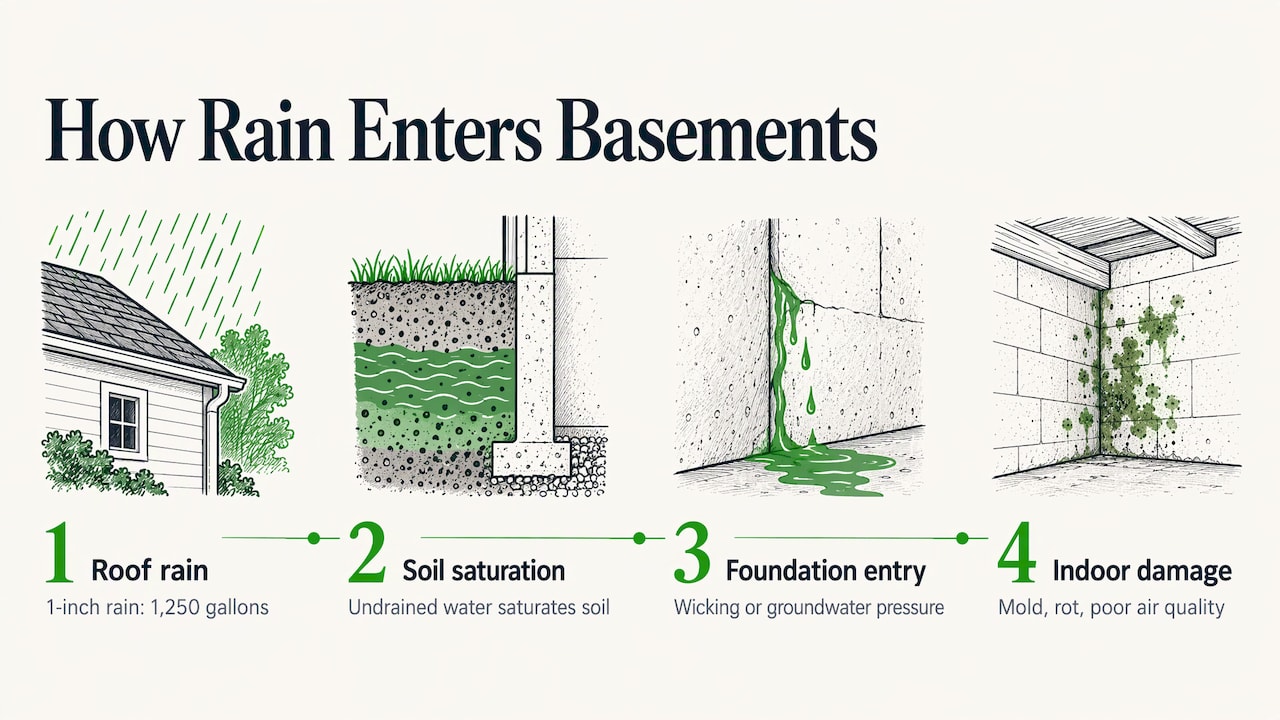
Rain is the most common source of basement water, and the numbers explain why. UMN Extension calculates that in a 1-inch rain, 1,250 gallons of water fall on the roof of a 2,000-square-foot house. Without proper grading, gutters and downspouts, some of that water ends up against the foundation and then inside.
The U.S. Department of Energy’s building science education pages describe what happens next: water that is not drained away from the house can quickly saturate the surrounding soil and wick through the foundation to the interior, causing mold, rot and indoor air quality problems.
Concrete itself is part of the story. The National Association of Home Builders’ guide to stopping basement leaks points out that concrete is porous and does not stop water migration. It absorbs water like a wick through capillary suction. And when the groundwater table rises above the level of the basement slab, Prince George’s County explains, pressure builds against the exterior walls. Without a system to relieve it, groundwater will eventually find its way in. This is why water often appears along the perimeter of the floor during storms and spring thaw.
New England adds its own pattern. Frozen ground, snowmelt and spring thaw can leave the soil around a foundation saturated for weeks, and the older stone and block foundations common across the Monadnock Region and north-central Massachusetts were built long before anyone expected a finished, insulated, dry living space below grade.
Why the floor is wet when nothing is leaking
A damp floor with no visible puddle is one of the most common complaints, and it usually comes down to moisture rather than a leak. Warm, humid air meets cold concrete and condenses. The EPA explains that as air cools it holds less moisture, so in cold weather moisture condenses on cold surfaces, which encourages mold and other biological pollutants to grow.
There is also a stack effect. UMN Extension notes that warm air rising through the house creates negative pressure in the basement, drawing moist air in through cracks and openings in the foundation, including open sump pits. Sump pits should have an airtight cover.
The EPA’s practical advice for controlling indoor moisture is straightforward: use exhaust fans in bathrooms and kitchens that vent outdoors, vent the clothes dryer outside, use dehumidifiers where the climate is hot and humid, and use a humidity indicator to measure the relative humidity in the house rather than guessing.
UMN Extension’s educators offer a useful order of operations: start with the easy, low-cost steps, such as removing internal moisture sources and ventilating, then move on to the next least costly measure. If humidity stays high after that, or the plastic sheet test shows moisture coming through the slab or wall, the problem is in the building envelope. Our guide to basement dehumidification for New England homes and the New England humidity insulation guide go deeper on that side of the problem.
Does homeowners insurance cover basement water?
Usually not, when the water seeps in. The Massachusetts government’s page on flood damage states that standard homeowners, renters and condo policies do not cover water damage from seepage through basement walls or floors, and that no endorsement is available to add this coverage. The Maryland Insurance Administration says much the same: seepage from the ground is generally excluded under most homeowners policies and is treated as a maintenance issue, in its natural disaster preparedness guide.
Policies differ, and a sudden plumbing failure is treated differently from groundwater, so call your insurer or agent before you start repairs and ask what your specific policy says. Photograph the damage first. The practical takeaway is simple: if water gets in through the walls or floor, the cost of fixing it is likely to be yours, which makes preventing the next episode worth more than repairing the last one.
Stopping water at the source
The cheapest improvements are outside. Start by sending roof water away from the house. The Department of Energy recommends appropriately sized gutters and downspouts, connected to piping that carries water to a sloping final grade more than 5 feet from the foundation, or to an underground catchment system more than 10 feet away that is not connected to the foundation drain.
The NAHB guide gives clear targets for the ground around the house:
- The soil should slope downward at least 6 inches in the first 10 feet away from the foundation.
- Downspouts and extensions should discharge at least 5 feet from the foundation.
- The ground surface should sit at least 6 inches below the top of the basement wall.
These are worth checking after the next heavy rain: look for water pooling near the foundation, downspouts dumping at the wall, and soil that slopes toward the house. NAHB also notes that basement leaks rarely point to a structural deficiency, but ending the source matters because saturated soil, rotting framing, damaged drywall, mold and pests all follow from leaving it.
Exterior fixes reduce the volume of water. They do not make a concrete or stone basement wall waterproof, and they do nothing for condensation and vapor moving through the slab. That is where treating the basement itself comes in.
Sealing and encapsulating the basement
When groundwater, seepage and humidity keep coming back, the lasting answer is to treat the basement as part of the building envelope. We offer basement water sealing and encapsulation for this reason: it addresses water and moisture where it enters, rather than just cleaning up after each storm. For a closer look at how it works in older homes, see our guide to basement encapsulation for New England homes.
The same logic applies to crawl spaces, where open dirt floors and vents pull humid air into the house. We handle crawl space and basement insulation as part of the same envelope work.
Diagnose before you spend
Guessing wrong is the most expensive mistake. Sealing a wall that is actually wet from condensation, or insulating a wall that is actually leaking, wastes money. Our home energy audits use blower door testing and thermal imaging to find air leaks and heat loss before we recommend a fix, so the plan follows what the house is doing rather than a standard package. You can read more about what a home energy audit for insulation finds and how audits reveal hidden home problems.
Moisture control and insulation belong together
A basement that stays dry is also easier to heat. Insulating basement walls and rim areas cuts the cold surfaces where condensation forms, and placement of the vapor barrier matters as much as the insulation itself. Our pages on basement insulation moisture control, moisture resistant basement insulation and vapor barrier placement explain how the layers fit together in New England homes, and does spray foam trap moisture answers the question most homeowners ask before choosing a material.
We install open-cell, closed-cell and HFO spray foam, blown-in cellulose, mineral wool and fiberglass, so the material can be matched to the space. For basement walls and rim joists, our spray foam insulation and mineral wool insulation pages describe the options.
Get your basement looked at
If you have water in your basement now, or it returns every spring, we can inspect it and recommend the right combination of sealing, encapsulation and insulation. We serve homeowners and builders across New Hampshire, Massachusetts, southern Maine and Vermont, with core markets including Keene, Peterborough, Jaffrey, Rindge, Nashua, Manchester, Fitchburg, Gardner and Leominster.

As an NHSaves contractor, we help New Hampshire homeowners access available energy efficiency rebates, and financing is available for insulation projects. Start with our basement water sealing and encapsulation service, or book an energy audit so the plan is based on measurements. We are BBB A+ accredited and members of the New Hampshire Home Builders Association.
What to check before and after any basement repair
Whatever route you take, a few checks keep the work on track:
- Dry first. Materials that stay wet beyond 24 to 48 hours risk mold, so do not insulate or finish over damp surfaces.
- Know your humidity. A humidity indicator costs little and tells you whether the basement is staying in a safe range. The EPA recommends measuring relative humidity rather than relying on how the room feels.
- Seal the sump. If you have a sump pit, an airtight cover stops humid air and radon-bearing soil air from entering the house.
- Watch after storms. Check walls and the floor perimeter after heavy rain and spring thaw. A stain that returns in the same place is a pattern worth acting on.
- Keep records. Photos, dates and repair invoices help with insurance and with a future sale.
FAQ
What should I do first if there is water in my basement?
Stay out until the electricity and gas are off and the structure looks sound. If you cannot reach the panel safely, call an electrician. Then stop the source, take photos, call your insurer and begin drying within 24 to 48 hours.
Why does my basement leak when it rains?
Rain runs off the roof and soaks the soil around your foundation. A 1-inch rain puts about 1,250 gallons on a 2,000-square-foot roof, and porous concrete can wick water through the wall. Poor grading and short downspouts make it worse.
Why is my basement floor wet but there is no leak?
Often it is condensation, where humid air meets cold concrete, or moisture moving up through the slab. The plastic sheet test shows which: moisture on the room side means condensation, and moisture under the sheet means it is coming through the concrete.
Does homeowners insurance cover water in the basement?
Standard policies generally exclude seepage through basement walls and floors, according to Massachusetts and Maryland insurance regulators. Sudden plumbing failures can be treated differently, so call your insurer before starting repairs and ask about your specific policy.
Why are basements so humid?
Cool concrete and soil chill the air, which then holds less moisture and condenses on surfaces. Dryers, showers and cooking add moisture, and warm air rising through the house pulls humid air in through foundation cracks and open sumps.
Sources
- MMSD: Why is There Water in My Basement?
- MU Extension: Removing water from flooded basements
- American Family Insurance: What to do if your basement floods
- State Farm: What To Do When Your Basement Floods in 10 Steps
- UMN Extension: Moisture in basements, causes and solutions
- Prince George’s County: A Homeowner’s Guide to Drainage Problems and Solutions
- DOE Building Science Education: Foundation, Drain, Gutters, Downspouts
- NAHB: Ultimate Guide to Stop Basement Water Leaks
- U.S. EPA: Main ways to control moisture in your home
- Mass.gov: Is My Flood Damage Covered?
- Maryland Insurance Administration: Insurance Preparedness Guide for Natural Disasters