
Controlling crawl space humidity means doing three things in order: stop liquid water, cover the soil and seal the air leaks, then dry the air that is left. Aim to keep relative humidity (RH) below 60% at all times, and ideally in the 30% to 50% range. Vents, a lone dehumidifier or a loose sheet of plastic rarely hold that number for long. In New England, where cool soil meets humid summer air, a sealed and conditioned crawl space is the setup that holds. We install crawl space encapsulation and insulation across New Hampshire, Massachusetts, southern Maine and Vermont, and this guide shows the full logic so you can judge what your crawl space needs.
TL;DR
- Keep crawl space RH below 60%, and ideally between 30% and 50%. Readings above 70% are a problem.
- Humidity comes from the ground, leaks, drainage and vented outdoor air. The cause decides the fix.
- Order matters: water management first, then a ground cover and air sealing, then drying the air.
- A dehumidifier alone often loses the fight when bare soil keeps feeding moisture into the space.
- Log readings for several days and across weather changes before you decide anything.
Table of Contents
- What humidity level should a crawl space hold?
- Reading humidity in winter
- Where crawl space moisture comes from
- How to reduce humidity in a crawl space: the order that works
- Why humidity keeps rising even with a dehumidifier
- Will mold grow at 55% humidity?
- What humidity control does for the house
- How we approach crawl space humidity
- Choosing a long-term approach
- Questions homeowners ask
- Sources
What humidity level should a crawl space hold?
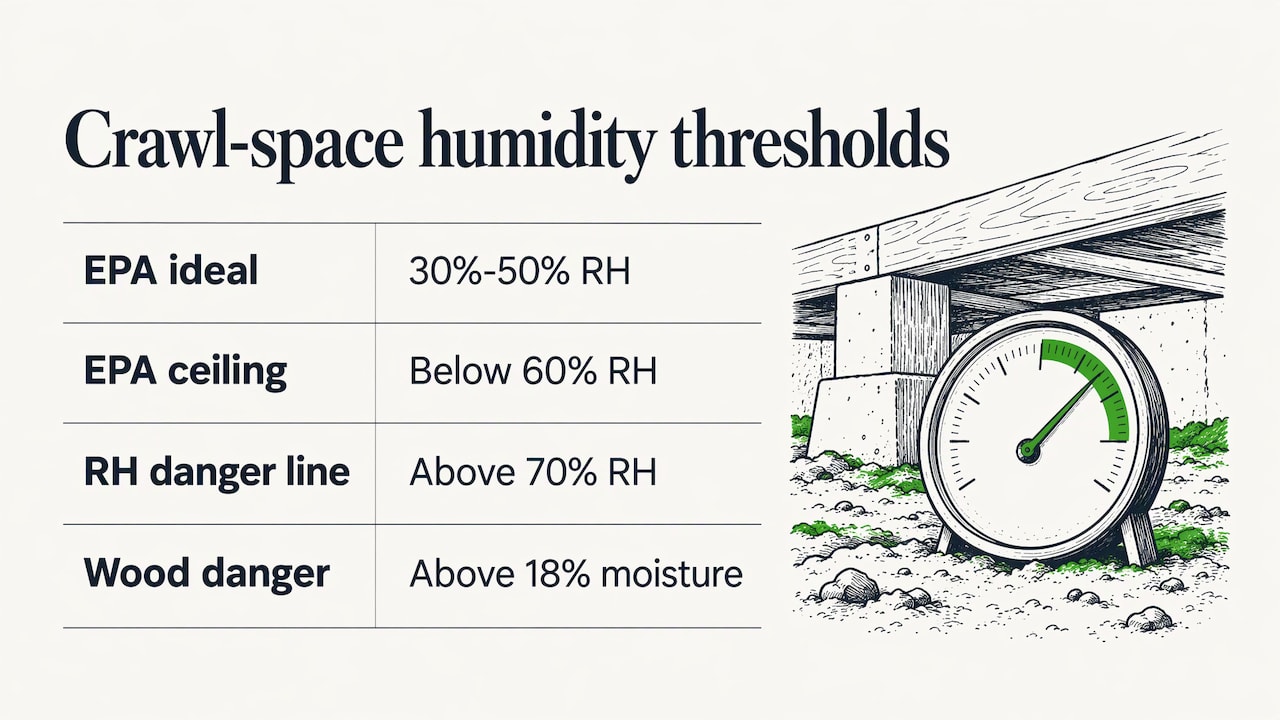
There is no single magic number, but the official guidance clusters in a clear band. The EPA advises keeping indoor humidity below 60% RH, ideally 30% to 50%, and that guidance is the baseline for any space under your house that shares air with your living areas.
For crawl spaces specifically, the U.S. Department of Energy’s Building America program notes that in some mild- or cold-climate areas where air conditioning is not typically used, a permanent dehumidifier tied to a sealed drain point might be needed to maintain 30% to 50% humidity. That describes a lot of older New England homes, which often have no central air at all.
The Building America Solution Center at Pacific Northwest National Laboratory puts the danger line higher. It treats air RH above 70% and wood moisture content above 18% as bad in a crawl space. Think of 70% as the point where damage is likely under way, not a target to approach.
A practical reading chart
Use this table to sort a reading. The bands come from the sources above; the action column is how we would read them for a typical New England crawl space.
| Crawl space RH | What it means | What to do |
|---|---|---|
| 30% to 50% | Within the range the DOE describes for conditioned crawl spaces | Keep monitoring, nothing to fix |
| 50% to 60% | Inside the EPA’s ceiling but with little margin | Look for the moisture source before a humid spell arrives |
| Above 60% | Over the EPA’s general ceiling | Find the source and plan a fix |
| Above 70% | Bad for a crawl space, per PNNL | Treat as urgent: check for leaks, torn ground cover, failed equipment |
Wood moisture content tells you more than air readings alone. Air humidity moves with the weather, while framing holds moisture for weeks. If joists read above 18%, the crawl space has been wet for a while, whatever the hygrometer says today.
Reading humidity in winter
Many homeowners check a cold-weather reading and relax when it looks low. That can mislead you. Outdoor air in winter carries less moisture, so a vented crawl space often reads lower from December through February. But a crawl space is also colder in winter, and relative humidity rises as air cools, so a reading can still come out high even when the outdoor air is dry.
Three habits make winter readings useful:
- Log, don’t glance. Place a digital hygrometer in the middle of the space, not next to the access door, and record it daily. A single reading tells you little, and a few days of logging shows the pattern.
- Compare with the weather. Note rain, snowmelt and thaws. A jump after a thaw points to water entering at the foundation, not to humid air.
- Treat a high winter number as a clue. When the air outside is cold and dry and the crawl space still reads high, something else is feeding it: bare soil, groundwater or a plumbing leak.
Winter is also the best time to look, since plumbing leaks, dryer exhaust and torn ground cover are easy to spot when the space is not crowded with summer humidity. Cold is also when frost shows you where warm indoor air leaks past the floor, which a thermal imaging scan makes obvious.
Where crawl space moisture comes from
Adding a dehumidifier before you know the source is like mopping under a running faucet. USDA Forest Service research on crawl spaces names the main sources of water: groundwater or rainwater intrusion, evaporation from the soil, and water vapor carried in with ventilation air. Here is how each shows up.
Bare soil
Exposed dirt is usually the largest steady source. It evaporates all year, and the vapor goes straight into the air your floor framing touches. The reading is typically high in every season and does not swing much with the weather.
Liquid water
Rain running toward the foundation, melting snow, a high water table or a leaking pipe all add liquid water. Readings spike after storms and thaws. The EPA lists sloping the ground away from the house among basic moisture-control measures, and that matters here because no interior system keeps up with water that keeps arriving. Check gutters, downspout discharge points and grading before anything else.
Humid outdoor air through vents
This one surprises people. Foundation vents were meant to dry crawl spaces, but the same USDA research explains that when the dew point of the incoming air is above the temperature of the soil, the air cannot remove moisture and instead adds it. That happens in humid spring weather while soil is still cool, and in summer when outdoor dew points exceed soil temperature. The researcher notes it is not limited to hot, humid regions and is also common in northern climates during summer.
The DOE guide adds that research has shown vented crawl spaces in mixed or hot-humid climates tend to raise moisture levels instead of lowering them, because moisture condenses on the cooler wood of the floor framing and promotes fungal growth and wood damage. Our New England humidity insulation guide covers why the region’s summers make this so common.
Household sources
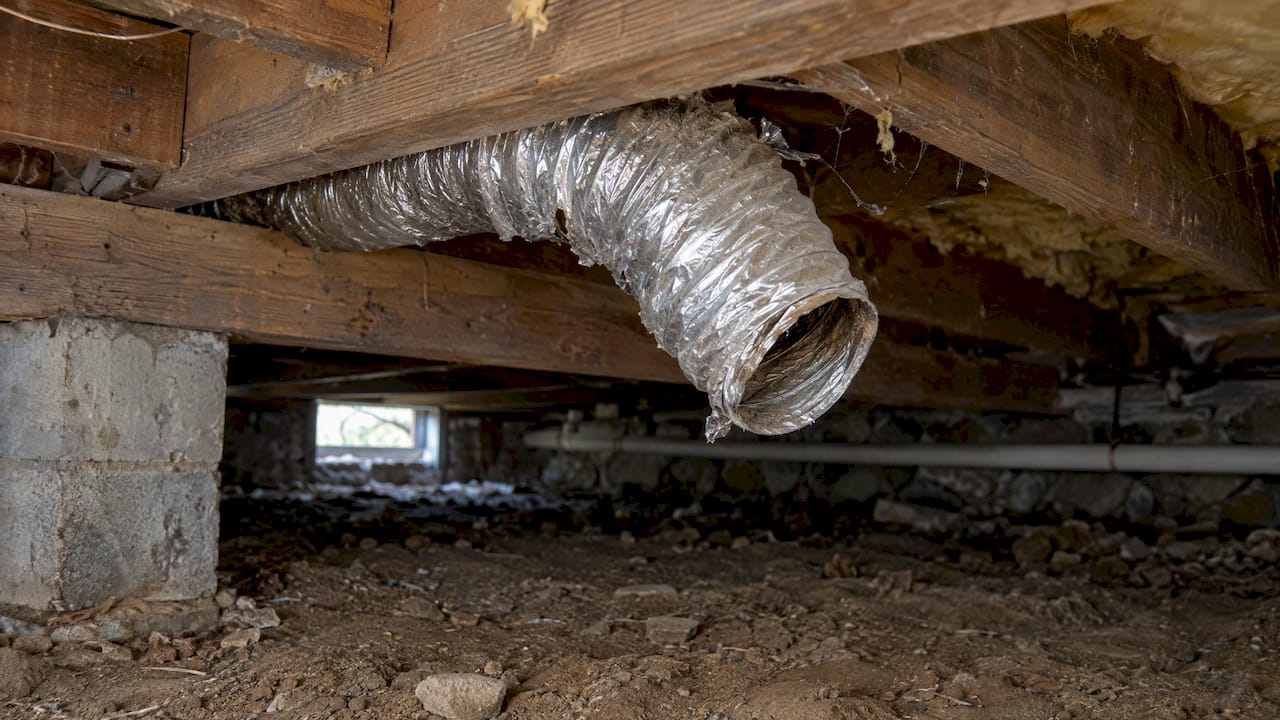
Bathroom fans, kitchen exhaust and clothes dryers that end in the crawl space dump moisture straight into it. Building America guidance says to use spot ventilation at the source and duct exhaust fans and dryers outdoors, not into an attic or crawl space. Follow every duct with a flashlight. A disconnected dryer hose is a surprisingly common find.
Failed equipment and torn barriers
PNNL lists a non-working dehumidifier, a torn or missing vapor barrier, and water entry from rain or melting ice as common causes of crawl space moisture problems. If humidity crept up after years of stable readings, check these first.
How to reduce humidity in a crawl space: the order that works
The sequence below matches what building scientists describe for closed crawl spaces. USDA researchers say a closed crawl space needs a ground cover to limit soil moisture, air sealing at the perimeter, and either conditioned air or direct dehumidification. Each step below says what it takes and where it tends to go wrong.
Step 1: Stop the water
Fix gutters, extend downspouts, regrade so the soil slopes away from the foundation, and repair any leaking plumbing. This is the one step that is more about your yard than about your crawl space. It goes wrong when people skip it and spend money on interior systems that then face a constant flow of liquid water. If groundwater or seepage still gets in after the exterior is sorted, basement and crawl space water sealing is the next layer, and it is work we do.
Step 2: Redirect household moisture
Duct every dryer, bath fan and range hood to the outdoors. Check that nothing terminates under the house. This is cheap and fast, and it removes a source that no dehumidifier should have to handle.
Step 3: Cover the soil
The EPA recommends putting a plastic cover over dirt in crawl spaces to block ground moisture. The scale of the problem explains why: one industry summary estimates exposed soil in a 1,000-square-foot crawl space can release 1 to 3 gallons of water vapor per day.
The thickness and seams matter. Codes show what a serious ground cover looks like. Washington State’s code requires six-mil ground cover overlapped at least 6 inches, and federal rules for manufactured homes require a vapor retarder of at least 6-mil polyethylene or equivalent under an enclosed home outside arid regions. These are other jurisdictions’ rules, so check what applies to your town, but they show the minimum standard that professionals work from. Where it goes wrong: thin sheeting laid loose, unsealed seams, no seal at piers and walls, and punctures from foot traffic. Our page on vapor barrier placement for New England homes walks through where the barrier belongs.
Step 4: Close the vents and seal the perimeter
Once the soil is covered, the vents become the next problem, since they let in the humid air described above. Sealing vents and the rim area turns the crawl space into part of the home’s conditioned envelope. Washington’s code for unvented crawl spaces calls for a continuous Class I vapor retarder sealed to the stem wall, a radon system and mechanical exhaust ventilation. That shows how seriously a sealed crawl space is treated: it is a designed system, not a plastic sheet.
This is also where air leaks around the rim joist, sill plate and penetrations get found. A blower door test and thermal imaging show where air moves, which is why we start with diagnostics before recommending a fix.
Step 5: Dry the air that remains
Sealing alone does not dry a crawl space. Residual soil moisture and leaks can still push humidity up, so a drying mechanism is part of the system. Building America guidance supports that, noting that a dehumidifier tied into a sealed drain point might be needed to maintain 30% to 50% humidity in climates without air conditioning. Our article on basement dehumidification for New England homes explains how drying fits a sealed space. The common failure here is a dehumidifier that sits in a space with open vents and bare soil: it runs constantly, drains a bucket that refills, and never gets ahead.
Step 6: Insulate the walls and keep watching
Once the space is sealed and dry, insulating the crawl space walls helps keep surfaces from getting cold enough to collect condensation. Our guide on how to insulate crawlspace walls in New England covers the materials and where each fits. Keep the hygrometer in place. A permanent reading is the cheapest way to catch a failed pump, a torn barrier or a new leak.
Why humidity keeps rising even with a dehumidifier
This is the most frequent frustration, and it has a short list of causes:
- Bare or poorly covered soil. The unit is removing vapor that the ground keeps replacing.
- Open vents. In humid weather the vents deliver more moisture than the unit can remove.
- Liquid water. Plumbing leaks, groundwater or poor drainage overwhelm the unit.
- A torn or missing barrier. PNNL lists this alongside a non-working dehumidifier as a common cause.
- The wrong spot. A unit near the access hatch measures and treats only part of the space, while the far corners stay damp.
If the crawl space is already sealed and covered and humidity is still high, dehumidification may simply be undersized, and the other sources above need to be ruled out. The pattern in your log helps: a steady high reading points to soil or capacity, while spikes after storms point to water entry.
Will mold grow at 55% humidity?
Mold needs moisture, and the EPA’s guidance centers on keeping indoor humidity below 60%, ideally 30% to 50%. At 55%, a crawl space sits under that ceiling, but with a thin margin. A damp week, a cool wood surface or a bit of condensation can push local conditions higher than the room average suggests, because the air near cold framing is more humid than the air in the middle of the space.
That is why a target in the 30% to 50% range is the safer aim. It gives you room for a humid spell without crossing 60%. Visible growth, a musty smell upstairs or wood moisture above 18% means conditions have already been wet, whatever the number reads today. If you see growth, wear a respirator and gloves and avoid disturbing it, and call a qualified mold professional for large areas. Once the area is clean, the moisture source still has to be fixed or the growth returns.
What humidity control does for the house
A dry crawl space protects the floor framing and subfloor from the fungal growth and wood damage the DOE describes in vented spaces. It also affects the living space above. Air moves up through floors in winter because warm air rises, so what is in the crawl space tends to reach the rooms. Our guide to improving crawlspace air quality goes into that connection.
Comfort and energy use follow. Cold, damp floors are a common complaint in older New England homes, and sealing and insulating the crawl space addresses both. The Centers for Disease Control’s NIOSH notes that temperature and relative humidity affect perceived comfort, which is why a clammy floor feels colder than the thermostat says.
How we approach crawl space humidity
We are an insulation and building envelope contractor based in Rindge, New Hampshire, and crawl spaces fall squarely in our work: crawl space and basement insulation, basement water sealing and crawl space encapsulation. We begin with a home energy audit that uses blower door testing and thermal imaging to find air leaks and heat loss before recommending a fix, so the plan targets what is actually wrong in your house.
You can read about the service on our crawl space and basement insulation page and our basement water sealing and encapsulation page. We serve homeowners across New Hampshire, Massachusetts, southern Maine and Vermont, including the Monadnock Region, Nashua, Manchester and north-central Massachusetts. As an NHSaves contractor, we help New Hampshire homeowners access available energy efficiency rebates, and financing is available.

If your crawl space log shows readings above 60%, or you have found bare soil, a torn barrier or damp insulation, start with an assessment on our home energy audits page.
Choosing a long-term approach
When you compare options for a damp crawl space, judge each against the sources of moisture, not the symptom.
| Approach | Handles liquid water | Handles soil vapor | Handles humid vent air | Dries remaining air |
|---|---|---|---|---|
| Dehumidifier only | No | Partly, by overworking | No | Yes |
| Ground cover only | No | Yes, if sealed | No | No |
| Vent fans or open vents | No | No | Adds moisture in humid weather | Only when outdoor air is drier than the soil |
| Sealed, conditioned crawl space | Needs water management first | Yes | Yes, vents are closed | Yes |
Only a sealed and conditioned crawl space covers every column, and it still depends on managing liquid water first. That is why encapsulation and water sealing sit together in our service list.
Questions homeowners ask
Should I dehumidify my crawl space?
In many cases yes, once the soil is covered and the vents are sealed. Building America guidance says a dehumidifier tied into a sealed drain point might be needed to hold 30% to 50% humidity in climates without air conditioning. Dehumidifying an open, vented crawl space with bare soil is much less effective.
What is a safe humidity level in winter?
The same target applies: below 60% and ideally 30% to 50%. Winter readings often run lower because outdoor air carries less moisture, but a persistently high reading in cold weather points to another source such as soil, groundwater or a leak.
How long should I monitor before deciding?
Track readings daily for at least several days and include a stretch of wet or thawing weather. One number on one afternoon says little, and the pattern shows whether the cause is the ground, the vents or a leak.
Why is my crawl space humid in summer even when the house feels dry?
Warm, humid outdoor air entering through vents meets cooler soil and framing. When the outdoor dew point is above the soil temperature, ventilation adds moisture. This is common in northern climates in summer, not only in the South.
Does sealing a crawl space remove humidity by itself?
No. Sealing stops new moisture from coming in, but moisture already in the soil and framing remains. A drying mechanism is part of the system, which is why encapsulation is paired with dehumidification.
Sources
- Guide to Closing and Conditioning Ventilated Crawlspaces, U.S. Department of Energy
- Moisture in Crawl Spaces, USDA Forest Service
- Look at Crawlspace for Moisture Issues, Building America Solution Center
- Managing Indoor Humidity and Ventilation in Cold Weather, Building America Solution Center
- What are the main ways to control moisture in your home? EPA
- Mold and Moisture Control Q&A, Colorado Department of Education (EPA guidance)
- Wash. Admin. Code 51-51-0408, Under-floor space
- Ground cover vapor barrier under manufactured homes, 24 CFR 3285.204
- Indoor Environmental Quality: Temperature, NIOSH
- The Crawl Space Humidity Fix: What Actually Works